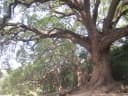
Cinnamomum camphora
Cinnamomum camphora
Cultivation Details
Cinnamomum camphora flourishes in warm temperate to subtropical climates, but also under tropical highland conditions[3]. It requires hot summers to thrive[4], and grows best in areas where the mean annual temperature is above 16°c[5]. Mature trees can withstand occasional frosts with temperatures falling to about -5°c (-10°c according to another report[6]), but young trees often succumb if temperatures fall below zero[3]. In its natural habitat annual rainfall ranges between 1,000 - 3,500mm spread throughout the year; higher rainfall is tolerated only on free draining soils because the tree has a shallow root system and does not tolerate waterlogging[3, 5]. Succeeds in most soils[6] but prefers a fertile sandy moisture-retentive well-drained soil in full sun or light part-day shade[7]. Plants are tolerant of saline soils and salt-laden winds[5]. Tolerates a pH in the range 4.3 to 8, but prefers a range from 6.5 - 8[3]. Camphor is grown commercially in China and Japan as a medicinal tree and also for its essential oil[8]. Camphor production should not start until trees are at least 20 years old[9]. Yields of 2 - 3% of essential oil by steam distillation can be expected[9]. Trees on lighter soils tend to have a higher essential oil content[3]. In areas with very high rainfall or after prolonged periods of very heavy rain, the camphor content of the essential oil is low[3]. Unshaded trees have the highest essential oil content[3]. There are some named varieties, selected for their ornamental value[7]. A very slow growing tree[1]. The roots are very sensitive to disturbance[10].
Propagation
Seed - the seed has a short viability and is best sown as soon as it is ripe in a greenhouse[7]. Remove the fruit pulp since this can inhibit germination[7]. Germination can take 1 - 6 months at 20°c[10]. Stored seed should be sown as soon as possible in a warm greenhouse[11]. When they are large enough to handle, prick the seedlings out into individual pots and grow them on in a greenhouse for at least their first winter. Plant them out into their permanent positions in late spring or early summer, after the last expected frosts. Consider giving them some protection from the cold for at least their first two winters outdoors. Cuttings of semi-ripe side shoots, 7cm with a heel, early summer/July in a frame with bottom heat[11]. Cite as: Temperate Plants Database, Ken Fern. temperate.theferns.info. 2026-02-20. <temperate.theferns.info/plant/Cinnamomum+camphora>
Pollinators
Diptera
References
- [1]A Modern Herbal. — Grieve. · Penguin · 1984 · ISBN 0-14-046-440-9 ↩︎Not so modern (1930's?) but lots of information, mainly temperate plants.
- [2]The Encyclopedia of Herbs and Herbalism — Stuart. M. (Editor) · Orbis Publishing. London. · 1979 · ISBN 0-85613-067-2 ↩︎Excellent herbal with good concise information on over 400 herbs.
- [3]World Agroforesty Centre — http://www.worldagroforestry.org/ ↩︎An excellent online database of a huge range of trees giving very good information on each plant - its uses, ecology, identity, propagation, pests etc.
- [4]New Trees — Grimshaw J.; Bayton R.; Wilks H. · Kew Publishing; London · 2009 · ISBN 1842461737 ↩︎Provides comprehensive botanical descriptions and horticultural commentary on over 800 tree species that have been introduced to cultivation in recent decades.
- [5]Seed Leaflets — Various · Forest & Landscape. Denmark · http://en.sl.life.ku.dk/Publikationer/Udgivelser/PopulaerPublikationer.aspx?katid={D28373CC-6EF3-4EF8-B097-6D83FABF209E}&serieid={9F1C3DB1-6E7B-4CF1-AF53-F480B0CB40EF}&sort=title ↩︎A series of leaflets, jointly produced by the University of Copenhagen and the Royal Botanic Gardens at Kew, focussing on seed information for a number species, but also giving a lot of other information about each plant.
- [6]Plants for Man. — Schery. R. W. ↩︎Fairly readable but not very comprehensive. Deals with plants from around the world.
- [7]The New RHS Dictionary of Gardening. 1992. — Huxley. A. · MacMillan Press · 1992 · ISBN 0-333-47494-5 ↩︎Excellent and very comprehensive, though it contains a number of silly mistakes. Readable yet also very detailed.
- [8]Dictionary of Economic Plants. — Uphof. J. C. Th. · Weinheim · 1959 · ISBN - ↩︎An excellent and very comprehensive guide but it only gives very short descriptions of the uses without any details of how to utilize the plants. Not for the casual reader.
- [9]Medicinal Plants of Vietnam, Cambodia and Laos. — Nguyen Van Duong · Mekong Printing; Vietnam (Printers) · 1993 · ISBN 0-9837303-1-2 ↩︎Published by the author, this is an excellent book on the medicinal attributes of plants growing in the area that used to be called Indo-China.
- [10]Growing from Seed. Volume 4. — Bird. R. (Editor) · Thompson and Morgan. · 1990 · ISBN - ↩︎Very readable magazine with lots of information on propagation. A good article on Yuccas, one on Sagebrush (Artemesia spp) and another on Chaerophyllum bulbosum.
- [11]Propagation of Trees, Shrubs and Conifers. — Sheat. W. G. · MacMillan and Co · 1948 · ISBN - ↩︎A bit dated but a good book on propagation techniques with specific details for a wide range of plants.
- [12]Ecocrop — http://ecocrop.fao.org/ecocrop/srv/en/home ↩︎Basic information on a wide range of useful plants, plus details of environmental needs where available.
- [13]Australian Tropical Rainforest Plants — http://www.anbg.gov.au/cpbr/cd-keys/rfk/index.html ↩︎An online resource giving botanical information, and a little bit about plant usage, for over 2,700 species of plants found in the Australian rainforest.
- [14]Plantae Wilsonae. Vol 1 - 3 — Wilson. E. H. · University Press; Cambridge. · 1911 - 1917 · http://www.biodiversitylibrary.org ↩︎Details of the palnts collected by the plant collector E. H. Wilson on his travels in China. Gives some habitats. Not for the casual reader. It can be downloaded from the internet.
- [15]Tanaka's Cyclopedia of Edible Plants of the World. — Tanaka. T. & Nakao S. · Keigaku Publishing; Tokyo · 1976 · ISBN - ↩︎The most comprehensive list of edible plants I've come across. Only the briefest entry for each species, though, and some of the entries are more than a little dubious. Not for the casual reader.
- [16]Plants for Human Consumption. — Kunkel. G. · Koeltz Scientific Books · 1984 · ISBN 3874292169 ↩︎An excellent book for the dedicated. A comprehensive listing of Latin names with a brief list of edible parts.
- [17]Cornucopia II — Facciola. S. · Kampong Publications, California. · 1998 · ISBN 0-9628087-2-5 ↩︎The second edition of an excellent guide to the edible uses of plants, though it does not give any details of cultivation etc.
- [18]The Encyclopedia of Medicinal Plants — Chevallier. A. · Dorling Kindersley. London · 1996 · ISBN 9-780751-303148 ↩︎An excellent guide to over 500 of the more well known medicinal herbs from around the world.
- [19]Handbook of Chinese Herbs and Formulas. — Yeung. Him-Che. · Institute of Chinese Medicine, Los Angeles · 1985 · ISBN - ↩︎An excellent Chinese herbal giving information on over 500 species. Rather technical and probably best suited to the more accomplished user of herbs.
- [20]Chinese Materia Medica. — Stuart. Rev. G. A. · Taipei. Southern Materials Centre · 1911 · ISBN - ↩︎A translation of an ancient Chinese herbal. Fascinating.
- [21]Encyclopaedia of Herbs and their Uses. — Bown. D. · Dorling Kindersley, London. · 1995 · ISBN 0-7513-020-31 ↩︎A very well presented and informative book on herbs from around the globe. Plenty in it for both the casual reader and the serious student. Just one main quibble is the silly way of having two separate entries for each plant.
- [22]Medicinal Plants of China — Duke. J. A. and Ayensu. E. S. · Reference Publications, Inc. · 1985 · ISBN 0-917256-20-4 ↩︎Details of over 1,200 medicinal plants of China and brief details of their uses. Often includes an analysis, or at least a list of constituents. Heavy going if you are not into the subject.
- [23]Glossary of Indian Medicinal Plants (Including the Supplement). — Chopra. R. N., Nayar. S. L. and Chopra. I. C. · Council of Scientific and Industrial Research, New Delhi. · 1986 · ISBN - ↩︎Very terse details of medicinal uses of plants with a wide range of references and details of research into the plants chemistry. Not for the casual reader.
- [24]Aromatherapy - A guide for home use. — Westwood. C. · Amberwood Publishing Ltd · 1993 · ISBN 0-9517723-0-9 ↩︎An excellent little pocket guide. Very concise.
- [25]RHS Dictionary of Plants plus Supplement. 1956 — F. Chittendon. · Oxford University Press · 1951 · ISBN - ↩︎Comprehensive listing of species and how to grow them. Somewhat outdated, it has been replaced in 1992 by a new dictionary (see [ 200 ]).
- [26]A Dictionary of Plants Used by Man. — Usher. G. · Constable · 1974 · ISBN 0094579202 ↩︎Forget the sexist title, this is one of the best books on the subject. Lists a very extensive range of useful plants from around the world with very brief details of the uses. Not for the casual reader.
- [27]Trees of Central Texas. — Vines. R. A. · University of Texas Press · 1987 · ISBN 0-292-78958-3 ↩︎A good concise guide, it gives details of habitats and some of the uses of trees growing in Texas.
- [28]Economic Botany. — Hill. A. F. · The Maple Press · 1952 · ISBN - ↩︎Not very comprehensive, but it is quite readable and goes into some detail about the plants it does cover.
- [29]CosIng — http://ec.europa.eu/growth/tools-databases/cosing/ ↩︎CosIng is the European Commission database for information on cosmetic substances and ingredients.
- [30]Scented Flora of the World. — Genders. R. · Robert Hale. London. · 1994 · ISBN 0-7090-5440-8 ↩︎An excellent, comprehensive book on scented plants giving a few other plant uses and brief cultivation details. There are no illustrations.
- [31]Flora of China — Missouri Botanical Garden Press; St. Louis. · 1994 · http://flora.huh.harvard.edu/china/ ↩︎An excellent, comprehensive resource in 25 volumes. In addition to the botanical information the flora also gives basic information on habitat and some uses. An on-line version is also available.
- [PFAF]Plants for a Future — pfaf.org ↩︎