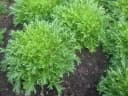
Cichorium endivia
Cichorium endivia
Safety & Hazards
None known
Cultivation Details
Originating in the warm temperate to subtropical zone, Endive can also be grown in cooler areas of the temperate zone and into the tropics, though it generally does best there at elevations above 400 metres. It grows best in areas where annual daytime temperatures are within the range 15 - 23°c, but can tolerate 5 - 30°c[1]. Older plants can survive temperatures down to about -5°c, but young growth can be severely damaged at -1°c[1]. It prefers a mean annual rainfall in the range 1,000 - 1,400mm, but tolerates 300 - 2,500mm[1]. It usually require long days for flowering and rarely flowers in the tropics - although there are reports of flowering at elevations above 1,500 metres in the tropics, probably helped by the lower temperatures there[1]. Prefers a sunny position[2] but with light shade in hot weather to prevent plants running to seed[3]. Succeeds in any moderately fertile well-drained soil[2]. Prefers a medium to light sandy or gravelly soil that is rich in humus[4, 5, 6]. Prefers a pH in the range 6.5 - 7.8, but tolerates 5.3 to 8.5[1]. Leaf yields can vary from 4 - 20 tonnes per hectare[1]. There are many named varieties, these falling into three basic groups:- Batavian Group. (also known as Escarole Group, Scarole Group or var. Latifolium). This form has broad, almost entire, rather flat leaves, forming a loose head; some well-known cultivars are 'Batavian Broad-Leaved', 'Escarole', 'Deep Heart Fringed', 'Growers Giant' and 'Géante maraîchère'[7]. Curled-leaved Group (also known as Curled Endive Group, Frisée Group or var. Crispum). This form has narrow, deeply pinnatifid, strongly curled leaves, forming a loose head; some well-known cultivars are 'Salad King', 'Green Curled', 'Frisée de Ruffec' and 'Grosse Pancalière'[7]. Cutting Group (also known as Small Endive Group, Endivia Group or var. Endivia). A form with very small leaves that do not form a head; cultivars belonging to this group are hardly grown anymore[7].
Propagation
Seed - sow in situ early to mid July for an autumn and winter crop and up to mid August for succession. Seedlings can be transplanted[2]. Successional sowings can also be made from mid spring onwards for a summer crop though these plants are liable to bolt in hot weather or if there is a cold snap in late spring[4, 2]. Cite as: Temperate Plants Database, Ken Fern. temperate.theferns.info. 2026-02-20. <temperate.theferns.info/plant/Cichorium+endivia>
Pollinators
Self, Bees
References
- [1]Ecocrop — http://ecocrop.fao.org/ecocrop/srv/en/home ↩︎Basic information on a wide range of useful plants, plus details of environmental needs where available.
- [2]The New RHS Dictionary of Gardening. 1992. — Huxley. A. · MacMillan Press · 1992 · ISBN 0-333-47494-5 ↩︎Excellent and very comprehensive, though it contains a number of silly mistakes. Readable yet also very detailed.
- [3]Rare Vegetables for Garden and Table. — Organ. J. · Faber · 1960 · ISBN - ↩︎Unusual vegetables that can be grown outdoors in Britain. A good guide.
- [4]RHS Dictionary of Plants plus Supplement. 1956 — F. Chittendon. · Oxford University Press · 1951 · ISBN - ↩︎Comprehensive listing of species and how to grow them. Somewhat outdated, it has been replaced in 1992 by a new dictionary (see [ 200 ]).
- [5]The Oxford Book of Food Plants. — Harrison. S. Wallis. M. Masefield. G. · Oxford University Press · 1975 · ISBN - ↩︎Good drawings of some of the more common food plants from around the world. Not much information though.
- [6]The Gardener's Assistant. — Thompson. B. · Blackie and Son. · 1878 · ISBN - ↩︎Excellent general but extensive guide to gardening practices in the 19th century. A very good section on fruits and vegetables with many little known species.
- [7]Protabase - Plant Resources of Tropical Africa. — http://www.prota.org ↩︎An excellent on-line database with detailed information on over 3,200 species of useful plants of Africa.
- [8]Flowers of the Mediterranean. — Polunin. O. and Huxley. A. · Hogarth Press · 1987 · ISBN 0-7012-0784-1 ↩︎A very readable pocket flora that is well illustrated. Gives some information on plant uses.
- [9]Sturtevant's Edible Plants of the World. — Hedrick. U. P. · Dover Publications · 1972 · ISBN 0-486-20459-6 ↩︎Lots of entries, quite a lot of information in most entries and references.
- [10]New Vegetable Growers Handbook. — Simons. · Penguin · 1977 · ISBN 0-14-046-050-0 ↩︎A good guide to growing vegetables in temperate areas, not entirely organic.
- [11]The Vegetable Garden. — Vilmorin. A. · Ten Speed Press · ISBN 0-89815-041-8 ↩︎A reprint of a nineteenth century classic, giving details of vegetable varieties. Not really that informative though.
- [12]Dictionary of Economic Plants. — Uphof. J. C. Th. · Weinheim · 1959 · ISBN - ↩︎An excellent and very comprehensive guide but it only gives very short descriptions of the uses without any details of how to utilize the plants. Not for the casual reader.
- [13]Salads all the Year Round. — Larkcom. J. · Hamlyn · 1980 ↩︎A good and comprehensive guide to temperate salad plants, with full organic details of cultivation.
- [14]Economic Botany. — Hill. A. F. · The Maple Press · 1952 · ISBN - ↩︎Not very comprehensive, but it is quite readable and goes into some detail about the plants it does cover.
- [15]Cornucopia - A Source Book of Edible Plants. — Facciola. S. · Kampong Publications · 1990 · ISBN 0-9628087-0-9 ↩︎Excellent. Contains a very wide range of conventional and unconventional food plants (including tropical) and where they can be obtained (mainly N. American nurseries but also research institutes and a lot of other nurseries from around the world.
- [16]Glossary of Indian Medicinal Plants (Including the Supplement). — Chopra. R. N., Nayar. S. L. and Chopra. I. C. · Council of Scientific and Industrial Research, New Delhi. · 1986 · ISBN - ↩︎Very terse details of medicinal uses of plants with a wide range of references and details of research into the plants chemistry. Not for the casual reader.
- [17]The Encyclopedia of Medicinal Plants — Chevallier. A. · Dorling Kindersley. London · 1996 · ISBN 9-780751-303148 ↩︎An excellent guide to over 500 of the more well known medicinal herbs from around the world.
- [PFAF]Plants for a Future — pfaf.org ↩︎