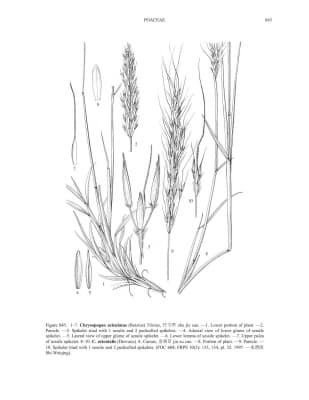
Chrysopogon orientalis
Chrysopogon orientalis
Safety & Hazards
None known
Cultivation Details
The plant is adapted to warm tropical climates in areas with high rainfall[1]. Well adapted to sandy soils , succeeding in extremely infertile soils, but also growing vigorously on heavy soils[1]. It grows best in open, sunny situations, but can also succeed in light shade, such as old coconut plantations[1]. First flowering starts about 11 weeks after germination, and seed reaches maturity at 13 weeks after sowing[2]. The plant is tolerant of heavy grazing and fire[2].
Propagation
Seed - requires light for germination and should be only just covered. It germinates within 5 days after sowing[2]. Division Cite as: Tropical Plants Database, Ken Fern. tropical.theferns.info. 2026-02-20. <tropical.theferns.info/viewtropical.php?id=Chrysopogon+orientalis>
Pollinators
Wind
References
- [1]Plant Resources of Southeast Asia — http://proseanet.org/ ↩︎Lots of information on the uses of the plants of SE Asia.
- [2]Grassland Species - Profiles — http://www.fao.org/ag/AGP/AGPC/doc/Gbase/Default.htm ↩︎Terse information on over 650 species of plants that grow in grassland, including trees, shrubs and perennial plants as well as grasses. Gives a brief description of the plant, its range and habitat and some of its uses.
- [3]Flora of China — Missouri Botanical Garden Press; St. Louis. · 1994 · http://flora.huh.harvard.edu/china/ ↩︎An excellent, comprehensive resource in 25 volumes. In addition to the botanical information the flora also gives basic information on habitat and some uses. An on-line version is also available.