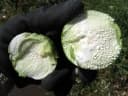
Chrysophyllum cainito
Chrysophyllum cainito
Safety & Hazards
None known
Cultivation Details
Star apple grows successfully in a range of tropical or near tropical areas. Throughout Southeast Asia it thrives in the lowlands, up to 400 metres elevation, and in areas with a distinct dry season[1]. If the dry period is most pronounced, undue loss of leaves and less juicy or even shrivelled fruit are evident, which indicates that the drought is too severe and irrigation is needed[1]. The temperature range for growth is reported to be 12 - 35°c with the optimum between 22 - 38°c[2]. Mature trees are seriously injured by temperatures below -2°c and recover slowly. Young trees may be killed by even short exposure to -0.5°c[2]. The annual rainfall range for growth is reported to be 800 - 2,200mm with the optimum between 1,000 - 1,400mm303]. Requires a moist, well-drained soil[3]. Prefers a deep, rich loam[4]. Fertile, well drained and slightly acid soils are ideal for good growth, though the plant can succeed on almost all types of soil[1]. Prefers a sunny position[5]. Established plants are tolerant of drought[5]. Trees take about 5 - 10 years to produce fruit from seed[3, 6]. Grafted plants can start to fruit in 2 - 4 years[6]. Some trees yield heavy crops of fruit, others bear little[2]. Young trees are sensitive to water stress in their first year, and growth during that time is slow. Once the tree is established, growth rate and development become more rapid. Deep mulching with straw or lawn clippings, application of fertilizer and frequent dry-season watering all seem necessary for success with this species[2]. The trees do not drop their fruit, making it necessary to climb the tree in order to harvest the crop[5]. There are many named varieties[7]. Star apple flowers are hermaphrodite, and the plants are usually self-fertile[8].
Propagation
Seed - sow in a light, sandy loam[2]. Germination rate is 70%, the seed taking up to six weeks to germinate[3, 2]. The seed retains its viability for several months[1]. The seedlings bear fruits in 5-10 years[1]. Greenwood cuttings. The cuttings taken from mature stems root well[1], when placed over strong moist heat[2]. Air layering. Takes 4 - 7 months[1]. Grafting. Grafted trees have been known to commence bearing in their first year[1]. Cite as: Tropical Plants Database, Ken Fern. tropical.theferns.info. 2026-02-20. <tropical.theferns.info/viewtropical.php?id=Chrysophyllum+cainito>
Pollinators
Data unavailable
References
- [1]Under-Utilized Tropical Fruits of Thailand. RAP — Suranant Subhadrabandhu · F. A. O., The United Nations, Bangkok. · 2001 · http://www.fao.org/3/a-ab777e.pdf ↩︎A detailed report on 35 fruit species that could have potential for increased production in Thailand. The report can be downloadd as a PDF from the internet.
- [2]World Agroforesty Centre — http://www.worldagroforestry.org/ ↩︎An excellent online database of a huge range of trees giving very good information on each plant - its uses, ecology, identity, propagation, pests etc.
- [3]Tropical Food Gardens — Norrington. L. · Bloomings Books (Melbourne) · 2001 · ISBN 1-876473-41-x ↩︎Excellent little book giving some basic information on a range of plants.
- [4]The New RHS Dictionary of Gardening. 1992. — Huxley. A. · MacMillan Press · 1992 · ISBN 0-333-47494-5 ↩︎Excellent and very comprehensive, though it contains a number of silly mistakes. Readable yet also very detailed.
- [5]Tropical and Subtropical Trees - A Worldwide Encyclopaedic Guide. — Barwick. M. · Thames & Hudson, London · 2004 · ISBN 0-500-51181-0 ↩︎A superb book, very concise and well written, giving a wealth of information on 400 or more species including descriptions, habitat, cultivation details and plant uses. A wealth of colour photographs bring each plant vividly to life.
- [6]Trade Winds Fruit — http://www.tradewindsfruit.com/index.htm ↩︎The on-line catalogue of a company selling seeds. Gives descriptions, photos and uses of a very wide range of fruit and other food-producing plants plus ornamentals.
- [7]Cornucopia II — Facciola. S. · Kampong Publications, California. · 1998 · ISBN 0-9628087-2-5 ↩︎The second edition of an excellent guide to the edible uses of plants, though it does not give any details of cultivation etc.
- [8]Perennial Edible Fruits of the Tropics : an Inventory — Martin, F. W.; Campbell, C. W.; Rubertbe, R. M. · U.S. Dept. of Agriculture, Agricultural Research Service · 1987 ↩︎A booklet giving terse details of almost 300 species of edible fruits, plus regional lists of Botanical and Common names for over 2,500 less well-known edible fruits of the tropics.
- [9]Digital Compendium of Forestry Species of Cambodia — www.digitalspecies.blogspot.com; Phnom Penh · 2008 · http://www.digitalspecies.blogspot.com ↩︎A very detailed booklet, produced in PDF format on the internet, giving information on around 100 species of trees.
- [10]Brazilian Fruits and Cultivated Exotics — Lorenzi. H.; Bacher. L.; Lacerda. M.; Sartori. S. · Instituto Plantarum De Estudos Da Flora LTDA; Brazil. · 2000 · ISBN 85-867174-24-0 ↩︎A superb book, giving information on several hundred fruit species. Each entry has a brief description of the plant and its uses, accompanied by one to many excellent quality photographs of the fruits.
- [11]Trees Commonly Cultivated in SE Asia — Jensen. M. · FAO Regional Office, Bangkok. · 1999 · ISBN 974-89377-5-5 ↩︎
- [12]Medicinal Plants of the Guianas — DeFilipps, R. A.; Maina, S. L.; & Crepin, J. · Smithsonian Museum · http://botany.si.edu/bdg/medicinal/index.html ↩︎A down-loadable PDF document of a book in pre-publication awaiting illustration. An excellent, if rather terse, guide to the traditional medicinal uses of the plants of the region