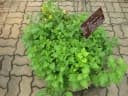
Chrysanthemum morifolium
Chrysanthemum morifolium
Safety & Hazards
None known
Cultivation Details
The cultivated chrysanthemum is commonly grown as an ornamental flowering plant. Although temperate in origin, it grows successfully in the tropics and is often grown in southeast Asia.This species is not fully hardy in Britain, many of its cultivars requiring greenhouse protection in the colder areas of the country[1]. Succeeds in most well-drained fertile soils in a sunny position[1, 2]. The chrysanthemum is widely cultivated as an ornamental flowering plant[2]. It is an enormous hybrid complex developed over many centuries (a Chinese account published in 1630 listed over 500 cultivars) into the huge array of ornamental cultivars available today. The primary parental species is Chrysanthemum indicum, but the other parents are now obscure[3]. The plant can flower all year round in warmer gardens[4].
Propagation
Seed - sow in a container and only just cover the seed. It usually germinates in 10 - 18 days at 15°c but if it does not germinate within 4 weeks then try chilling the seed for 3 weeks in the salad compartment of a fridge[5]. When they are large enough to handle, prick the seedlings out into individual pots and plant them out when large enough. This is a hybrid species and so will not breed true from seed. Division. Larger clumps can be replanted direct into their permanent positions, though it is best to pot up smaller clumps and grow them on until they are rooting well. Cite as: Tropical Plants Database, Ken Fern. tropical.theferns.info. 2026-02-20. <tropical.theferns.info/viewtropical.php?id=Chrysanthemum+morifolium>
Pollinators
Insects
References
- [1]RHS Dictionary of Plants plus Supplement. 1956 — F. Chittendon. · Oxford University Press · 1951 · ISBN - ↩︎Comprehensive listing of species and how to grow them. Somewhat outdated, it has been replaced in 1992 by a new dictionary (see [ 200 ]).
- [2]The New RHS Dictionary of Gardening. 1992. — Huxley. A. · MacMillan Press · 1992 · ISBN 0-333-47494-5 ↩︎Excellent and very comprehensive, though it contains a number of silly mistakes. Readable yet also very detailed.
- [3]Flora of China — Missouri Botanical Garden Press; St. Louis. · 1994 · http://flora.huh.harvard.edu/china/ ↩︎An excellent, comprehensive resource in 25 volumes. In addition to the botanical information the flora also gives basic information on habitat and some uses. An on-line version is also available.
- [4]Plant Resources of Southeast Asia — http://proseanet.org/ ↩︎Lots of information on the uses of the plants of SE Asia.
- [5]Growing from Seed. Volume 4. — Bird. R. (Editor) · Thompson and Morgan. · 1990 · ISBN - ↩︎Very readable magazine with lots of information on propagation. A good article on Yuccas, one on Sagebrush (Artemesia spp) and another on Chaerophyllum bulbosum.
- [6]Oriental Herbs and Vegetables, Vol 39 No. 2. — Brooklyn Botanic Garden · Brooklyn Botanic Garden · 1986 · ISBN - ↩︎A small booklet packed with information.
- [7]Dictionary of Economic Plants. — Uphof. J. C. Th. · Weinheim · 1959 · ISBN - ↩︎An excellent and very comprehensive guide but it only gives very short descriptions of the uses without any details of how to utilize the plants. Not for the casual reader.
- [8]Famine Foods listed in the Chiu-Huang Pen-ts'ao. — Reid. B. E. · Southern Materials Centre; Taipei · 1977 · ISBN - ↩︎A translation of an ancient Chinese book on edible wild foods. Fascinating.
- [9]Cornucopia - A Source Book of Edible Plants. — Facciola. S. · Kampong Publications · 1990 · ISBN 0-9628087-0-9 ↩︎Excellent. Contains a very wide range of conventional and unconventional food plants (including tropical) and where they can be obtained (mainly N. American nurseries but also research institutes and a lot of other nurseries from around the world.
- [10]Tanaka's Cyclopedia of Edible Plants of the World. — Tanaka. T. & Nakao S. · Keigaku Publishing; Tokyo · 1976 · ISBN - ↩︎The most comprehensive list of edible plants I've come across. Only the briefest entry for each species, though, and some of the entries are more than a little dubious. Not for the casual reader.
- [11]Encyclopaedia of Herbs and their Uses. — Bown. D. · Dorling Kindersley, London. · 1995 · ISBN 0-7513-020-31 ↩︎A very well presented and informative book on herbs from around the globe. Plenty in it for both the casual reader and the serious student. Just one main quibble is the silly way of having two separate entries for each plant.
- [12]The Encyclopedia of Medicinal Plants — Chevallier. A. · Dorling Kindersley. London · 1996 · ISBN 9-780751-303148 ↩︎An excellent guide to over 500 of the more well known medicinal herbs from around the world.
- [13]A Barefoot Doctors Manual. — ? · Running Press; Philadelphica. · 1977 · ISBN 0-914294-92-X ↩︎A very readable herbal from China, combining some modern methods with traditional chinese methods.
- [14]Handbook of Chinese Herbs and Formulas. — Yeung. Him-Che. · Institute of Chinese Medicine, Los Angeles · 1985 · ISBN - ↩︎An excellent Chinese herbal giving information on over 500 species. Rather technical and probably best suited to the more accomplished user of herbs.
- [15]Medicinal Plants of China — Duke. J. A. and Ayensu. E. S. · Reference Publications, Inc. · 1985 · ISBN 0-917256-20-4 ↩︎Details of over 1,200 medicinal plants of China and brief details of their uses. Often includes an analysis, or at least a list of constituents. Heavy going if you are not into the subject.
- [16]Eco-Friendly House Plants. — Wolverton. B. C. · Weidenfeld & Nicolson. London. · 1996 · ISBN 0-297-83484-3 ↩︎Excellent guide to pollution in the home and those plants that can help to remove the problem. Most of the plants are not hardy outdoors in the temperate zone, though a number of species can be grown outside.