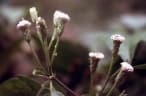
Chromolaena odorata
Chromolaena odorata
Safety & Hazards
When applied as a green manure in rice paddies, compounds in the plant may kill fish[1].
Cultivation Details
A plant of the warm and humid tropics and subtropics, where it is found at elevations up to 1,000 metres. It grows best in areas where annual daytime temperatures are within the range 20 - 35°c, but can tolerate 16 - 38°c[2]. It can be killed by temperatures of -1°c or lower[2]. It prefers a mean annual rainfall in the range 2,000 - 4,000mm, but tolerates 1,500 - 5,000mm[2]. Requires a sunny position[2]. Succeeds in many soil types, but prefers well-drained soils[2]. Prefers a pH in the range 5 - 6.5, tolerating 4 - 7.5[2]. Commonly grown as an ornamental, in recent decades the plant has become a serious pest in the humid tropics of South East Asia, Africa and the Pacific Islands. It has small, wind-dispersed seeds that can also cling to hair, clothing and shoes. It spreads rapidly in lands used for forestry, pasture and plantation crops such as rubber, coffee, coconut, cocoa and cashew[2]. The leaves and petioles have glandular dots emitting a strong pungent smell when crushed - phenols and alkaloids in the plant, in particular in the leaves, have an allelopathic effect, inhibiting the germination of its own seeds and seedling development of other plants[1, 3]. The plant forms dense stands in disturbed land, preventing the establishment of other species, both due to competition and allelopathic effects[4].
Propagation
Seed - it requires light to germinate and is best sown very near the surface, but it may still emerge when buried up to 3cm deep[1]. Emergence takes 4 - 12 days[1]. During the first 3 months of growth the seedlings stay rather small and mainly form leaves. Later, the length and biomass of the stem increase rapidly. Before growing downwards, the primary root forms a small, horizontal part, from which many secondary roots develop. During further growth it swells progressively and serves as a storage organ from which new shoots may sprout[1] Viability of fresh seed ranges from 33 - 66%. A small proportion of the seed will germinate when freshly harvested, but most remains dormant - after 2 years up to 40% of the seed will still germinate[1]. Cuttings - the nodes of branches readily root when in contact with moist soil[1]. Root cuttings Cite as: Tropical Plants Database, Ken Fern. tropical.theferns.info. 2026-02-20. <tropical.theferns.info/viewtropical.php?id=Chromolaena+odorata>
Pollinators
Data unavailable
References
- [1]Plant Resources of Southeast Asia — http://proseanet.org/ ↩︎Lots of information on the uses of the plants of SE Asia.
- [2]Ecocrop — http://ecocrop.fao.org/ecocrop/srv/en/home ↩︎Basic information on a wide range of useful plants, plus details of environmental needs where available.
- [3]Flowers of India — http://www.flowersofindia.net/ ↩︎A wed site of native Indian plants, plus cultivated and naturalized species. It has good quality photos and terse details on more than 3,000 species and cultivars.
- [4]Pacific Island Ecosystems at Risk — http://www.hear.org/pier/scientificnames/index.html ↩︎A very good website detailing weed species that have been introduced into the Pacific Islands.
- [5]Asean Tropical Plant Database — http://211.114.21.20/tropicalplant/index.jsp ↩︎Terse details, with photos, of many of the plants growing in the tropical forests of southeast Asia. Gives some details of plant uses along with a description of the plant and its range.
- [6]Traditional Vegetables in Benin — Achigan-Dako E. Et al · Darwin Initiative; International Foundation for Science · 2009 ↩︎Issued as a PDF on the Internet, it contains basic information on over 250 species of plants used for food in Benin.
- [7]Medicinal Plants of the Guianas — DeFilipps, R. A.; Maina, S. L.; & Crepin, J. · Smithsonian Museum · http://botany.si.edu/bdg/medicinal/index.html ↩︎A down-loadable PDF document of a book in pre-publication awaiting illustration. An excellent, if rather terse, guide to the traditional medicinal uses of the plants of the region