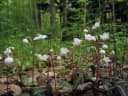
Chimaphila maculata
Chimaphila maculata
Safety & Hazards
None known
Cultivation Details
A plant mainly of the temperate zone, also growing at higher elevations in the tropics of Central America. Requires a light moist but well-drained lime-free soil and shade from direct sunlight[1]. This species is difficult to propagate and grow in cultivation, mainly because it has certain mycorrhizal associations in the wild and these are necessary if the plant is to thrive[2]. It is best to use some soil collected from around an established plant when sowing seed or planting out into a new position[2]. The plant has wide-spreading fibrous feeding roots and will often die or fail to increase in size if these are disturbed. The flowers are deliciously scented[3].
Propagation
Seed - very difficult to germinate, see the notes in cultivation details. It is best sown on moist sphagnum peat. As soon as they are large enough to handle, prick the seedlings out into individual pots and grow them on in a shady position in the greenhouse for at least their first winter. Plant them out into their permanent positions in late spring or early summer, after the last expected frosts. Division. Rather difficult because the plant is very sensitive to root disturbance. It is best attempted in the spring as the plant comes into growth[2]. Cuttings of softwood, early summer in a frame. Use some soil from around an established plant[4]. Cite as: Temperate Plants Database, Ken Fern. temperate.theferns.info. 2026-02-20. <temperate.theferns.info/plant/Chimaphila+maculata>
Pollinators
Data unavailable
References
- [1]RHS Dictionary of Plants plus Supplement. 1956 — F. Chittendon. · Oxford University Press · 1951 · ISBN - ↩︎Comprehensive listing of species and how to grow them. Somewhat outdated, it has been replaced in 1992 by a new dictionary (see [ 200 ]).
- [2]The New RHS Dictionary of Gardening. 1992. — Huxley. A. · MacMillan Press · 1992 · ISBN 0-333-47494-5 ↩︎Excellent and very comprehensive, though it contains a number of silly mistakes. Readable yet also very detailed.
- [3]Scented Flora of the World. — Genders. R. · Robert Hale. London. · 1994 · ISBN 0-7090-5440-8 ↩︎An excellent, comprehensive book on scented plants giving a few other plant uses and brief cultivation details. There are no illustrations.
- [4]Complete Guide to Herbs. — Holtom. J. and Hylton. W. · Rodale Press · 1979 · ISBN 0-87857-262-7 ↩︎A good herbal.
- [5]A Field Guide to Medicinal Plants. Eastern and Central N. America. — Foster. S. & Duke. J. A. · Houghton Mifflin Co. · 1990 · ISBN 0395467225 ↩︎A concise book dealing with almost 500 species. A line drawing of each plant is included plus colour photographs of about 100 species. Very good as a field guide, it only gives brief details about the plants medicinal properties.
- [6]An Illustrated Flora of the Northern United States and Canada — Britton. N. L. Brown. A. · Dover Publications. New York. · 1970 · ISBN 0-486-22642-5 ↩︎Reprint of a 1913 Flora, but still a very useful book.
- [7]Flora of Guatemala — Standley P.C. & J. A. Steyermark · 1946 - 1976 · http://www.archive.org/ ↩︎A superb reference, though somewhat dated. Gives lots of plant uses as well as information on plant habit and habitat. The entire flora (13 volumes) can now be downloaded from http://www.archive.org/
- [8]Cornucopia - A Source Book of Edible Plants. — Facciola. S. · Kampong Publications · 1990 · ISBN 0-9628087-0-9 ↩︎Excellent. Contains a very wide range of conventional and unconventional food plants (including tropical) and where they can be obtained (mainly N. American nurseries but also research institutes and a lot of other nurseries from around the world.
- [9]Native American Ethnobotany — Moerman. D. · Timber Press. Oregon. · 1998 · ISBN 0-88192-453-9 ↩︎Very comprehensive but terse guide to the native uses of plants. Excellent bibliography, fully referenced to each plant, giving a pathway to further information. Not for the casual reader.
- [10]A Modern Herbal. — Grieve. · Penguin · 1984 · ISBN 0-14-046-440-9 ↩︎Not so modern (1930's?) but lots of information, mainly temperate plants.
- [11]The History and Folklore of North American Wild Flowers. — Coffey. T. · Facts on File. · 1993 · ISBN 0-8160-2624-6 ↩︎A nice read, lots of information on plant uses.