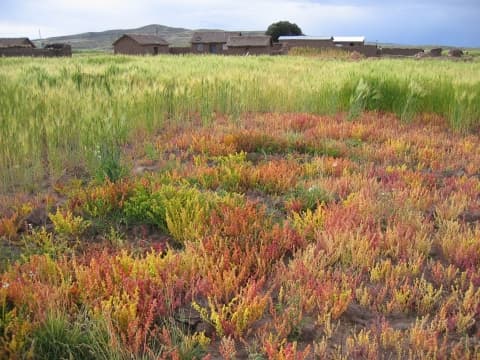
Chenopodium pallidicaule
Chenopodium pallidicaule
Safety & Hazards
The leaves and seeds of all members of this genus are more or less edible. However, many of the species in this genus contain saponins, though usually in quantities too small to do any harm. Although poisonous, saponins also have a range of medicinal applications and many saponin-rich plants are used in herbalism (particularly as emetics, expectorants and febrifuges) or as sources of raw materials for the pharmaceutical industry. Saponins are also found in a number of common foods, such as many beans. Saponins have a quite bitter flavour and are in general poorly absorbed by the human body, so most pass through without harm. They can be removed by carefully leaching in running water. Thorough cooking, and perhaps changing the cooking water once, will also normally remove most of them. However, it is not advisable to eat large quantities of raw foods that contain saponins. Saponins are much more toxic to many cold-blooded creatures, such as fish, and hunting tribes have traditionally put large quantities of them in streams, lakes etc in order to stupefy or kill the fish and make them easy to catch[PFAF]. The plants also contain some oxalic acid, which in large quantities can lock up some of the nutrients in the food. However, even considering this, they are very nutritious vegetables in reasonable quantities. Cooking the plants will reduce their content of oxalic acid. People with a tendency to rheumatism, arthritis, gout, kidney stones or hyperacidity should take especial caution if including this plant in their diet since it can aggravate their condition[1].
Cultivation Details
A plant of high elevations in the tropics where it can be found at elevations up to 4,000 metres. Adult plants are unaffected by night frosts in the growing season, the seed can germinate at a soil temperature of 5°c, whilst the plant will flower at 10°c and ripen its seed at 15°c[2]. Succeeds on most soils, including shallow soils, but dislikes shade[2, 3]. Prefers a moderately fertile soil[3]. Once the plant is about 5cm tall it is very drought tolerant[2]. The plant has short stout stems and resists wind and heavy rain[2]. It is also more resistant than barley or quinoa to low night temperatures[2]. Plants do not like excess humidity[2]. They tolerate a pH in the range from 4.8 to 8.5 and show some salt tolerance[2]. The seed is somewhat laborious to harvest and dehusk, it is enveloped in a papery husk and this is removed by soaking in water and then rubbing[2]. Most varieties take about 150 days from seed sowing to harvest, but at least one quick-maturing type can be harvested in 95 days[2]. Yields of 2.4 tonnes per hectare are average, but twice this has been recorded[2]. Plants seem to be quite resistant to most pests and diseases[2]. The flowers are closed at fertility and so seem to be almost exclusively self-pollinating[2]. Plants are day-length neutral and have matured crops as far north as latitude 64°north in Finland[2]. Although used in much the same way, this species is not very closely related to quinoa, C. Quinoa[2].
Propagation
Seed - sow spring in situ. Most of the seed usually germinates within a few days of sowing. Cite as: Temperate Plants Database, Ken Fern. temperate.theferns.info. 2026-02-20. <temperate.theferns.info/plant/Chenopodium+pallidicaule>
Pollinators
Wind, Self
References
- [1]Encyclopaedia of Herbs and their Uses. — Bown. D. · Dorling Kindersley, London. · 1995 · ISBN 0-7513-020-31 ↩︎A very well presented and informative book on herbs from around the globe. Plenty in it for both the casual reader and the serious student. Just one main quibble is the silly way of having two separate entries for each plant.
- [2]Lost Crops of the Incas — Popenoe. H. et al · National Academy Press · 1990 · ISBN 0-309-04264-X ↩︎An excellent book. Very readable, with lots of information and good pictures of some lesser known food plants of S. America.
- [3]The New RHS Dictionary of Gardening. 1992. — Huxley. A. · MacMillan Press · 1992 · ISBN 0-333-47494-5 ↩︎Excellent and very comprehensive, though it contains a number of silly mistakes. Readable yet also very detailed.
- [4]Cornucopia - A Source Book of Edible Plants. — Facciola. S. · Kampong Publications · 1990 · ISBN 0-9628087-0-9 ↩︎Excellent. Contains a very wide range of conventional and unconventional food plants (including tropical) and where they can be obtained (mainly N. American nurseries but also research institutes and a lot of other nurseries from around the world.
- [5]Vegetables — Phillips. R. & Rix. M. · Macmillan Reference Books, London. · 1995 · ISBN 0 333 62640 0 ↩︎Excellent and easily read book with good information and an excellent collection of photos of vegetables from around the world, including many unusual species.
- [6]A Dictionary of Plants Used by Man. — Usher. G. · Constable · 1974 · ISBN 0094579202 ↩︎Forget the sexist title, this is one of the best books on the subject. Lists a very extensive range of useful plants from around the world with very brief details of the uses. Not for the casual reader.
- [7]Plants for Man. — Schery. R. W. ↩︎Fairly readable but not very comprehensive. Deals with plants from around the world.
- [8]The Ethno-Botany of Pre-Columbian Peru. — Towle. M. A. · Aldine Publishing Co. Chicago. · 1961 ↩︎A very interesting book covering quite a lot of information on plant uses in S. America although many of the plants are not suitable for temperate areas.
- [9]Tanaka's Cyclopedia of Edible Plants of the World. — Tanaka. T. & Nakao S. · Keigaku Publishing; Tokyo · 1976 · ISBN - ↩︎The most comprehensive list of edible plants I've come across. Only the briefest entry for each species, though, and some of the entries are more than a little dubious. Not for the casual reader.
- [10]Plants for Human Consumption. — Kunkel. G. · Koeltz Scientific Books · 1984 · ISBN 3874292169 ↩︎An excellent book for the dedicated. A comprehensive listing of Latin names with a brief list of edible parts.
- [11]Nature's Colors - Dyes from Plants. — Grae. I. · MacMillan Publishing Co. New York. · 1974 · ISBN 0-02-544950-8 ↩︎A very good and readable book on dyeing.
- [PFAF]Plants for a Future — pfaf.org ↩︎