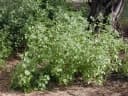
Chenopodium oahuense
Chenopodium oahuense
Safety & Hazards
None known
Cultivation Details
Requires a sunny position or light shade and a well-drained soil[1]. Plants are very tolerant of corraline soils[2]. The plant appears well adapted to tolerate drought by dying-back during periods of low moisture and then rapidly growing during periods of higher available moisture[1]. Tolerant of strong winds and salt spray[2]. The plant grows rapidly and remains fleshy during the first several months of growth. In later stages, the branches become brittle and are easily damaged. However larger, older individuals become single-stemmed and develop thickened woody branches[1]. Peak flowering and seed production are linked to favourable environmental conditions, though the plant can generally be found flowering and seeding throughout the year. Seed production is extremely high for this species[1]. The plant recovers well after fire. Following a wildfire in one area on Hawaii, reestablishment was delayed for approximately 1 year. Within 4 years, however, the plant had exceeded its preburn density by approximately 15-fold[1].
Propagation
Seed bearing utricles are easily collected by hand, don't bury them deep. The seeds start to germinate in 1 week and continue for another 2 - 3 weeks. The first or second set of true leaves appear in 1 month and at this stage the seedlings should be transplanted to individual pots. Two to three months after they reach 30cm, they should be planted out[3]. Cite as: Tropical Plants Database, Ken Fern. tropical.theferns.info. 2026-02-20. <tropical.theferns.info/viewtropical.php?id=Chenopodium+oahuense>
Pollinators
Data unavailable
References
- [1]Wildland Shrubs of the United States and its Territories: Thamnic Descriptions — Francis J.K. (Editor) · USDA; Forest Service International Institute of Tropical Forestr · 2000 · http://www.fs.fed.us/global/iitf/wildland_shrubs.htm ↩︎An excellent series of papers, in PDF format, from various authors giving quite detailed information on a range of shrubs growing in the United States and its Territories. It can be downloaded from the Internet.
- [2]Native Plants Hawaii — http://nativeplants.hawaii.edu/plant/ ↩︎A website containing information on a range of native Hawaiian plants, with descriptions, habitat, traditional uses etc.
- [3]Hawaiian Ethnobotany Online Database — http://www2.bishopmuseum.org/ethnobotanydb/index.asp ↩︎Brief details on over 100 species of Hawaiian plants.