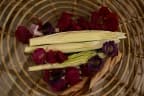
Chamaedorea tepejilote
Chamaedorea tepejilote
Safety & Hazards
The juice of the fruit of most members of this genus is said to be an irritant to the skin[1].
Cultivation Details
A plant of the moist tropics, where it is found at elevations up to 1,600 metres. It grows best in areas where annual daytime temperatures are within the range 20 - 28°c, but can tolerate 15 - 32°c[2]. It can be killed by temperatures of 2°c or lower[2]. Plants can tolerate occasional light frosts[3]. It prefers a mean annual rainfall in the range 1,000 - 2,500mm, but tolerates 700 - 3,000mm[2]. An easily grown plant if its basic requirements are met[1]. It requires at least moderate shade, and can tolerate deep shade[1]. It requires a well-drained, moist, humus-rich soil[1, 4]. Prefers a pH in the range 6.5 - 7.5, tolerating 6 - 8[2]. A variable plant in the wild, with some forms growing 7 metres or more tall and others only 2 metres[1]. A fast-growing plant, producing flowers and fruit when only a few years old[1]. A dioecious species - both male and female forms need to be grown if fruit and seed are required[1, 5].
Propagation
Seed - Cite as: Tropical Plants Database, Ken Fern. tropical.theferns.info. 2026-02-20. <tropical.theferns.info/viewtropical.php?id=Chamaedorea+tepejilote>
Pollinators
Data unavailable
References
- [1]Palms of the World — Blombery. A. & Rodd. T. · Angus and Robertson · 1992 · ISBN 0-207-14848-1 ↩︎An excellent guide, well illustrated, with information on cultivation, uses, habitat etc of almost 200 species of Palms.
- [2]Ecocrop — http://ecocrop.fao.org/ecocrop/srv/en/home ↩︎Basic information on a wide range of useful plants, plus details of environmental needs where available.
- [3]Desert Tropicals — http://www.desert-tropicals.com/ ↩︎The main focus of the site is succulent plants, but it also contains information on a wide range of other species. Usually at least one good photograph, plus basic information about the plant and its cultivation.
- [4]Palm and Cycad Societies of Australia. — http://www.pacsoa.org.au/ ↩︎Contains at least a little information on the majority of palm and cycad species, plus a wealth of photographs. A first class website.
- [5]Field Guide to the Palms of the Americas — Henderson A.; Galeano G.; Bernal R. · Princeton University Press; Princeton, New Jersey. · 1995 · ISBN 0-691-08537-4 ↩︎An excellent book, giving basic information on all the 550 species of palms native to the Americas that were known in 1995. Comprehensive information on the plants range and habitat, brief description, some uses and almost 250 photos.
- [6]The New RHS Dictionary of Gardening. 1992. — Huxley. A. · MacMillan Press · 1992 · ISBN 0-333-47494-5 ↩︎Excellent and very comprehensive, though it contains a number of silly mistakes. Readable yet also very detailed.
- [7]Ethnobotany of the Waimiri Atroari Indians of Brazil. — Milliken W.; Miller R.P.; Pollard S.R.; Wandelli E.V. · Royal Botanic Gardens, Kew. · 1992 · ISBN 0-947643-50-8 ↩︎An excellent and well-researched small book giving information on the lifestyle of the Waimiri Atroari and listing the plants used.
- [8]Cornucopia II — Facciola. S. · Kampong Publications, California. · 1998 · ISBN 0-9628087-2-5 ↩︎The second edition of an excellent guide to the edible uses of plants, though it does not give any details of cultivation etc.
- [9]Heart of Palm Use: A Family Survey — Scott Zona, Ph.D. · Fairchild Tropical Botanic Garden, Virtual Herbarium. · http://www.virtualherbarium.org/palmresearch/Hearts_of_Palm_table.html ↩︎An on-line article listing the botanical names and range of palm trees that have an edible apical bud.
- [PFAF]Plants for a Future — pfaf.org ↩︎