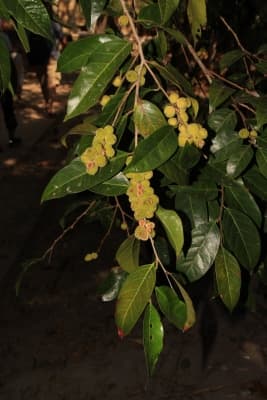
Chaetocarpus castanocarpus
Chaetocarpus castanocarpus
Safety & Hazards
None known
Cultivation Details
A plant of the lowland tropics, found naturally at elevations below 500 metres[1]. Grows naturally on yellow, brown or black sandy soil, sandy loam, sandstone, yellow clay, clay-loam, rocky coral, or granite[1]. According to Whitmore (1973), the plant is a calcifuge (is calcicole meant here?[PFAF]), because it is common along the coast in NE Malaysia and the inland collections may reflect old Pleistocene shore lines. However, the plants are also found in a far more acid surrounding, therefore it is more likely to be a very tolerant species capable of growing in a wide variety of soils[1]. Plants can flower and fruit the whole year through[1]. A dioecious species, both male and female forms need to be grown if fruit and seed are required[2].
Propagation
Seed - Cite as: Tropical Plants Database, Ken Fern. tropical.theferns.info. 2026-02-20. <tropical.theferns.info/viewtropical.php?id=Chaetocarpus+castanocarpus>
Pollinators
Data unavailable
References
- [1]Euphorbiaceae of Malesia — http://www.nationaalherbarium.nl/euphorbs/ ↩︎An online resource that is still being developed, it gives detailed botanical descriptions of plants in the family Euphorbiaceae found growing in Malesia (the region from Peninsual Malaysia through Indonesia, the Philippines).
- [2]Flora of China — Missouri Botanical Garden Press; St. Louis. · 1994 · http://flora.huh.harvard.edu/china/ ↩︎An excellent, comprehensive resource in 25 volumes. In addition to the botanical information the flora also gives basic information on habitat and some uses. An on-line version is also available.
- [3]Biotik, Laos — http://biotik.org/species_list_laos.html ↩︎Information on more than 100 species of Laotian trees.
- [4]Plants of Southeast Asia — http://www.asianplant.net/ ↩︎Excellent site with brief information on the plant, its range, habitat and uses, plus phots of specimens, close-ops of flowers and leaves etc,
- [PFAF]Plants for a Future — pfaf.org ↩︎