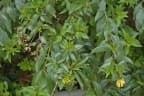
Cestrum parqui
Cestrum parqui
Safety & Hazards
All parts of the plant are poisonous[1]. The toxic principles are solanine-type glyco-alkaloids and atropine-like alkaloids. The symptoms are headache, dizziness, hallucinations, nausea, vomiting, bloody diarrhoea, muscular spasms and nervousness, high temperature, salivation and sweating, paralysis and coma[2].
Cultivation Details
A plant of low to fairly high elevations in the tropics and subtropics. Fairly frost-tolerant, able to survive occasional temperatures down to at least -5°c - even if the top growth is killed, the plant will often resprout from the base[3]. Grows well in full sun and in light shade[3, 4]. Succeeds in any reasonably fertile, free-draining soil[3]. This species exhibits vigorous growth and out competes most native vegetation. With its extensive, shallow root system, it is extremely difficult to eradicate[1]. It has become an invasive weed in some areas of the tropics and subtropics[1]. Plants can be pruned annually after flowering in order to keep them compact[4]. All parts of the plant emit a foul aroma[5]. The flowers have an unpleasant odour by day that is similar to urine, but they become fragrant at night[1].
Propagation
Seed - Soft tip cuttings. Cuttings of semi-ripe wood, 8 - 10cm long[3]. Cite as: Tropical Plants Database, Ken Fern. tropical.theferns.info. 2026-02-20. <tropical.theferns.info/viewtropical.php?id=Cestrum+parqui>
Pollinators
Data unavailable
References
- [1]Global Invasive Species Database — http://www.issg.org/database/welcome/ ↩︎Very detailed information on almost 400 species (with more being added) of plants that have become weeds in areas outside their native range.
- [2]Poisonous Plants of North Carolina — http://www.ces.ncsu.edu/depts/hort/consumer/poison/poison.htm ↩︎An excellent concise but comprehensive guide to toxic plants that grow in N. Carolina. It lists even those plants that are of very low toxicity, including several well-known food plants such as carrots and potatoes.
- [3]The New RHS Dictionary of Gardening. 1992. — Huxley. A. · MacMillan Press · 1992 · ISBN 0-333-47494-5 ↩︎Excellent and very comprehensive, though it contains a number of silly mistakes. Readable yet also very detailed.
- [4]Desert Tropicals — http://www.desert-tropicals.com/ ↩︎The main focus of the site is succulent plants, but it also contains information on a wide range of other species. Usually at least one good photograph, plus basic information about the plant and its cultivation.
- [5]Flowers of India — http://www.flowersofindia.net/ ↩︎A wed site of native Indian plants, plus cultivated and naturalized species. It has good quality photos and terse details on more than 3,000 species and cultivars.
- [6]Philippine Medicinal Plants — http://www.stuartxchange.org/CompleteList.html ↩︎A lovely site, giving brief details on the medicinal uses of several hundred (over 400 at the last count) plants in the Philippines, plus a picture of each plant.