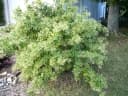
Cestrum nocturnum
Cestrum nocturnum
Safety & Hazards
All parts of the plant are poisonous[1]. The toxic principles are solanine-type glyco-alkaloids and atropine-like alkaloids. The symptoms are headache, dizziness, hallucinations, nausea, vomiting, bloody diarrhoea, muscular spasms and nervousness, high temperature, salivation and sweating, paralysis and coma[2].
Cultivation Details
The mature plant is hardy to about -4°c, but without protection, the new growth is likely to be killed at around 1°c[3]. Grows well in full sun and in light shade[4, 3]. Succeeds in any reasonably fertile, free-draining soil[4]. The species has been introduced as an ornamental in many tropical and subtropical regions of the world. It has became widely naturalized and is sometimes invasive, forming dense impenetrable stands which limit the regeneration of native species[1]. Plants can be pruned annually after flowering in order to keep them compact[3]. The greenish white flowers, which open at night, are powerfully fragrant[3]. At a distance the aroma resembles that of valerian, but at close range it is rank and overpowering[5].
Propagation
Seed - Soft tip cuttings. Cuttings of semi-ripe wood, 8 - 10cm long[4]. Cite as: Tropical Plants Database, Ken Fern. tropical.theferns.info. 2026-02-20. <tropical.theferns.info/viewtropical.php?id=Cestrum+nocturnum>
Pollinators
Data unavailable
References
- [1]Global Invasive Species Database — http://www.issg.org/database/welcome/ ↩︎Very detailed information on almost 400 species (with more being added) of plants that have become weeds in areas outside their native range.
- [2]Poisonous Plants of North Carolina — http://www.ces.ncsu.edu/depts/hort/consumer/poison/poison.htm ↩︎An excellent concise but comprehensive guide to toxic plants that grow in N. Carolina. It lists even those plants that are of very low toxicity, including several well-known food plants such as carrots and potatoes.
- [3]Desert Tropicals — http://www.desert-tropicals.com/ ↩︎The main focus of the site is succulent plants, but it also contains information on a wide range of other species. Usually at least one good photograph, plus basic information about the plant and its cultivation.
- [4]The New RHS Dictionary of Gardening. 1992. — Huxley. A. · MacMillan Press · 1992 · ISBN 0-333-47494-5 ↩︎Excellent and very comprehensive, though it contains a number of silly mistakes. Readable yet also very detailed.
- [5]The Useful Plants of the Island of Guam — Safford W.E. · Smithsonian Institute; Washington. · 1905 · http://www.biodiversitylibrary.org/ ↩︎A very comprehensive, if rather dated, guide to the plants of Guam. It can be downloaded from the Internet.
- [6]Mansfeld's Database of Agricultural and Horticultural Plants — http://mansfeld.ipk-gatersleben.de/pls/htmldb_pgrc/f?p=185:3:4292127278597336 ↩︎Terse details of a huge range of useful plants.
- [7]Pacific Island Ecosystems at Risk — http://www.hear.org/pier/scientificnames/index.html ↩︎A very good website detailing weed species that have been introduced into the Pacific Islands.
- [8]Cornucopia II — Facciola. S. · Kampong Publications, California. · 1998 · ISBN 0-9628087-2-5 ↩︎The second edition of an excellent guide to the edible uses of plants, though it does not give any details of cultivation etc.
- [9]Philippine Medicinal Plants — http://www.stuartxchange.org/CompleteList.html ↩︎A lovely site, giving brief details on the medicinal uses of several hundred (over 400 at the last count) plants in the Philippines, plus a picture of each plant.
- [PFAF]Plants for a Future — pfaf.org ↩︎