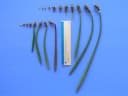
Ceriops tagal
Ceriops tagal
Safety & Hazards
None known
Cultivation Details
A plant of tropical and subtropical coastal areas, growing best where temperatures range from 20°c to 26°c and average annual rainfall from 750 mm to 1,500 mm[1]. Grows in areas of seasonal rainfall and also in areas where it can rain all year round[2]. Usually grows on well-drained soils within the reach of occasional tides[2]. Prefers a pH in the range 6 to 8.5[1]. The seed germinates while the fruit is still attached to the plant and develops a massive hypocotyl, which contains the food reserve for the seedling. The hypocotyl hangs down from the fruit with the true root at the end. The root has small outgrowths, which are the branch roots all ready to grow out. The plumule too is well-developed, but is enclosed in a sheath holding it in the fruit until the seedling drops from the tree. Seedlings fall like a dart to lodge upright in soft mud into which they penetrate to some depth. They become anchored by the outgrowth of the branch roots and so have a good chance of retaining a hold in the scour of the tide. The seedling is buoyant and if it does not stick in the mud where it drops because of a high tide or for some other reason, it may be transported by water. The seedling becomes established quite quickly. Upward growth carrying the seedling leaves above the level of the flood tide is very rapid and growth may be as much as 60 cm in 24 hours. Later the growth rate declines and seedling development can take a year[1]. Flowers open mostly in the evening and remain open the following day, emitting a faint but fragrant odour. Pollination is probably by night-flying insects, although bees also visit the flowers at daytime. Pollen release is explosive and is triggered by delicately touching the petals, which each hold a stamen pair[1]. Plants do not respond to coppicing[1].
Propagation
Seed - commences germination whilst still on the tree and is best harvested at this stage and planted out into its permanent site. The seedlings are small and delicate and should be collected and transported to the planting areas with care[1]. Seedlings do not tolerate excessive desiccation, but they establish quickly[1]. Cite as: Tropical Plants Database, Ken Fern. tropical.theferns.info. 2026-02-20. <tropical.theferns.info/viewtropical.php?id=Ceriops+tagal>
Pollinators
Insects
References
- [1]Protabase - Plant Resources of Tropical Africa. — http://www.prota.org ↩︎An excellent on-line database with detailed information on over 3,200 species of useful plants of Africa.
- [2]World Agroforesty Centre — http://www.worldagroforestry.org/ ↩︎An excellent online database of a huge range of trees giving very good information on each plant - its uses, ecology, identity, propagation, pests etc.
- [3]Plant Resources of Southeast Asia — http://proseanet.org/ ↩︎Lots of information on the uses of the plants of SE Asia.
- [4]IUCN Red List of Threatened Species — http://www.iucnredlist.org/ ↩︎A list of plants under threat and facing possible extinction, usually with brief details of the threats and information on habitat.