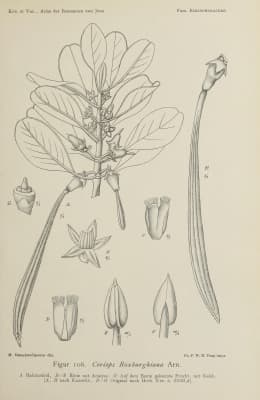
Ceriops decandra
Ceriops decandra
Safety & Hazards
None known
Cultivation Details
A plant mainly of high rainfall areas in the tropics[1]. The plant can grow in saline soils, it has a maximum tolerance of salinity at 67ppt and a salinity of optimal growth at15 ppt[2]. A slow-growing species, though it can be tolerant of extreme environmental conditions[2]. Trees tend to flower periodically and synchronously over wide areas, but seasonally under seasonal climates[1]. Fruiting is often prolific. Seeds germinate and start to develop whilst still on the tree, with individual trees producing several thousands of seedlings at the same time. The seedlings take up to 12 months to develop, with shorter times in wet equatorial regions, and then fall. Subsequent development involves a seedling being stranded and lodged in the mud, followed by the rapid production of adventitious roots which serve to anchor it. Most seedlings are slender and small and cannot survive long periods while floating in the water, and consequently are not as successfully dispersed over long distances as those of other mangrove Rhizophoraceae. However, once 'planted' in the shade of other trees their rate of establishment is very high[1].
Propagation
Seed - Cite as: Tropical Plants Database, Ken Fern. tropical.theferns.info. 2026-02-20. <tropical.theferns.info/viewtropical.php?id=Ceriops+decandra>
Pollinators
Data unavailable
References
- [1]Plant Resources of Southeast Asia — http://proseanet.org/ ↩︎Lots of information on the uses of the plants of SE Asia.
- [2]IUCN Red List of Threatened Species — http://www.iucnredlist.org/ ↩︎A list of plants under threat and facing possible extinction, usually with brief details of the threats and information on habitat.
- [3]Flora Malesiana Series 1 — Various · Nationaal Herbarium Nederiand, Universiteit Leiden branch · http://www.archive.org ↩︎A massive treatment of the plants of the Malaysian Archipelago. Much of it has been made available to download from the Internet