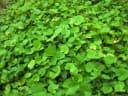
Centella asiatica
Centella asiatica
Safety & Hazards
There is a warning that the plant can irritate the skin[1], though it is also widely used to treat skin complaints[1]. The sensitizing capacity of the raw extract and its triterpenic constituents asiaticoside, asiatic acid, madecassoside and madecassic acid has been studied - all were found to be very weak sensitizers; even when applied frequently to damaged skin, the risk of acquiring contact sensitivity is low[2]. The plant is toxic in large overdose or as a result of long-term application. It can produce narcotic effects, headache, vertigo, and, occasionally in sensitive individuals, it may even lead to coma[2].
Cultivation Details
Centella asiatica is a plant of moist climates in lowland tropical and subtropical areas. It is not a very cold-hardy plant, but can tolerate short periods where temperatures might fall as low as -5 to -10°c[3]. Prefers a moist to wet soil in sun or partial shade[1]. The plant can grow and flower all year round in moist climates, though it dies down in the dry season in monsoon climatesl[2]. The plant can grow and spread very well outdoors during the summer months in warm temperate areas, and it is very easy to increase by division. It can therefore be grown as a summer crop in these areas with divisions being taken during the growing season and overwintered in a greenhouse in case the outdoor plants are killed by winter cold[PFAF]. Two forms of the plant are distinguished in Sri Lanka - a small creeping form and an erect bushy form with large leaves and petioles - it is this latter form that is the most popular and is often cultivated as a vegetable[2]. If circumstances are favourable, the first harvest can be obtained 2 - 3 months after planting. Subsequent harvests are possible every 2 months if only leaves are to be harvested. However, creeping types are usually harvested as whole plants. For medicinal use, whole plants are generally harvested at any suitable time of the year[2]. The yield of bushy forms may reach 8 tonnes per hectare of fresh leaves for the first harvest, and 14 tonnes for each subsequent harvest. Yields of the creeping types are lower[2]. Fresh leaves harvested as a vegetable are tied together in small bundles and need to be marketed quickly, as they wilt rapidly[2].
Propagation
Seed - sow spring in a greenhouse[1]. Prick out the seedlings into individual pots when they are large enough to handle and grow them on in a greenhouse for their first winter. Plant them out in late spring or early summer of the following year, after the last expected frosts[PFAF]. Division is simple at any time in the growing season, though the spring is probably best[PFAF]. We find that it is best to pot up the divisions until they are rooting away well, though in selected mild gardens it should be possible to plant the divisions out directly into their permanent positions[PFAF]. Cite as: Temperate Plants Database, Ken Fern. temperate.theferns.info. 2026-02-20. <temperate.theferns.info/plant/Centella+asiatica>
Pollinators
Bees, Insects
References
- [1]Encyclopaedia of Herbs and their Uses. — Bown. D. · Dorling Kindersley, London. · 1995 · ISBN 0-7513-020-31 ↩︎A very well presented and informative book on herbs from around the globe. Plenty in it for both the casual reader and the serious student. Just one main quibble is the silly way of having two separate entries for each plant.
- [2]Plant Resources of Southeast Asia — http://proseanet.org/ ↩︎Lots of information on the uses of the plants of SE Asia.
- [3]The New RHS Dictionary of Gardening. 1992. — Huxley. A. · MacMillan Press · 1992 · ISBN 0-333-47494-5 ↩︎Excellent and very comprehensive, though it contains a number of silly mistakes. Readable yet also very detailed.
- [4]Mansfeld's Database of Agricultural and Horticultural Plants — http://mansfeld.ipk-gatersleben.de/pls/htmldb_pgrc/f?p=185:3:4292127278597336 ↩︎Terse details of a huge range of useful plants.
- [5]Flora of Japan. (English translation) — Ohwi. G. · Smithsonian Institution · 1965 · ISBN - ↩︎The standard work. Brilliant, but not for the casual reader.
- [6]A Barefoot Doctors Manual. — ? · Running Press; Philadelphica. · 1977 · ISBN 0-914294-92-X ↩︎A very readable herbal from China, combining some modern methods with traditional chinese methods.
- [7]Cornucopia II — Facciola. S. · Kampong Publications, California. · 1998 · ISBN 0-9628087-2-5 ↩︎The second edition of an excellent guide to the edible uses of plants, though it does not give any details of cultivation etc.
- [8]Plants and People of Nepal — Manandhar. N. P. · Timber Press. Oregon. · 2002 · ISBN 0-88192-527-6 ↩︎Excellent book, covering over 1,500 species of useful plants from Nepal together with information on the geography and peoples of Nepal. Good descriptions of the plants with terse notes on their uses.
- [9]The Encyclopedia of Medicinal Plants — Chevallier. A. · Dorling Kindersley. London · 1996 · ISBN 9-780751-303148 ↩︎An excellent guide to over 500 of the more well known medicinal herbs from around the world.
- [10]Glossary of Indian Medicinal Plants (Including the Supplement). — Chopra. R. N., Nayar. S. L. and Chopra. I. C. · Council of Scientific and Industrial Research, New Delhi. · 1986 · ISBN - ↩︎Very terse details of medicinal uses of plants with a wide range of references and details of research into the plants chemistry. Not for the casual reader.
- [11]Medicinal Plants in Vietnam — Nguyen Van Dan & Doan Thi Nhu · World Health Organisation · 1989 · ISBN 92 9061 101 4 ↩︎An excellent book, giving information on over 200 plants, their medicinal compounds and applications.
- [12]Australian Medicinal Plants. — Lassak. E. V. and McCarthy. T. · New Holland Publishers · 2001 · ISBN 1876334703 ↩︎A very good and readable guide to the subject.
- [13]Ginkgo. Elixir of Youth. — Hobbs. C. · Botanica Press, California. · 1994 · ISBN 0-9618470-3-4 ↩︎Looks in detail at the medicinal virtues and also mentions some of the plants other uses. The information on traditional Chinese use and modern herbal use of the plant is backed up by an extensive bibliography.
- [PFAF]Plants for a Future — pfaf.org ↩︎