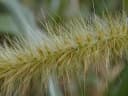
Cenchrus purpureus
Cenchrus purpureus
Safety & Hazards
None known
Cultivation Details
A plant of the moist tropics, it can also be grown in subtropical and warm temperate regions. It is found at elevations from near sea level to 2,000 metres in the tropics[1]. It grows best in areas where the mean annual temperature falls within the range 21 - 40°c, but can tolerate 15 - 45°c[1]. Plants can survive occasional light frosts[1]. It prefers a mean annual rainfall in the range 1,500 - 2,500mm, tolerating 850 - 4,000mm[1]. Grows best in a sunny position, but tolerates light shade[1]. Succeeds in most soils - although it can persist and compete in dry, sandy soils, it grows best in rich, well-drained conditions[2, 3]. Established plants have a deep root system and are extremely drought tolerant[2, 4, 5]. It prefers a pH in the range 5 - 6.5, tolerating 4.5 - 8.2[1]. The plant has escaped from cultivation and become naturalized in many parts of the tropics and subtropics[4]. In moist rich places it forms reed jungles, thereby eliminating the use of such land for cultivation[2]. It forms dense perennial stands, difficult to penetrate, which inhibits establishment of other vegetation[2]. A fast-growing plant, under favourable conditions it can reach a height of several metres within 60 days[1]. Plants recover well after fire, and can become the dominant vegetation in fire-affected savannah communities[5]. Seed set is usually poor, possibly due to low pollen viability[5].
Propagation
Seed - Vegetative propagation is either by dividing clumps of roots and stubble, or by stem cuttings consisting of at least three nodes, two of which are buried[4]. Cite as: Tropical Plants Database, Ken Fern. tropical.theferns.info. 2026-02-20. <tropical.theferns.info/viewtropical.php?id=Cenchrus+purpureus>
Pollinators
Wind
References
- [1]Ecocrop — http://ecocrop.fao.org/ecocrop/srv/en/home ↩︎Basic information on a wide range of useful plants, plus details of environmental needs where available.
- [2]Pacific Island Ecosystems at Risk — http://www.hear.org/pier/scientificnames/index.html ↩︎A very good website detailing weed species that have been introduced into the Pacific Islands.
- [3]Annals of the Missouri Botanical Garden Vol. 65 — Missouri Botanical Garden · 1978 ↩︎An excellent botanical publication, available for download from the Internet. This volume contains parts of the Flora of Panama.
- [4]Plant Resources of Southeast Asia — http://proseanet.org/ ↩︎Lots of information on the uses of the plants of SE Asia.
- [5]Tropical Forages — http://www.tropicalforages.info/key/Forages/Media/Html/index.htm ↩︎Mainly focussed on forage plants, the site gives a lot of information on the plant, with a good botanical description, details of cultivation, plant uses and a good selection of photographs.
- [6]The Useful Plants of West Tropical Africa. — Burkil. H. M. · Royal Botanic Gardens; Kew. · 1985 - 2004 ↩︎Brief descriptions and details of the uses of over 4,000 plants. A superb, if terse, resource, it is also available electronically on the Web - see http://www.aluka.org/
- [7]Mansfeld's Database of Agricultural and Horticultural Plants — http://mansfeld.ipk-gatersleben.de/pls/htmldb_pgrc/f?p=185:3:4292127278597336 ↩︎Terse details of a huge range of useful plants.
- [8]Dictionary of Economic Plants. — Uphof. J. C. Th. · Weinheim · 1959 · ISBN - ↩︎An excellent and very comprehensive guide but it only gives very short descriptions of the uses without any details of how to utilize the plants. Not for the casual reader.
- [9]Plants for Man. — Schery. R. W. ↩︎Fairly readable but not very comprehensive. Deals with plants from around the world.
- [10]A Dictionary of Plants Used by Man. — Usher. G. · Constable · 1974 · ISBN 0094579202 ↩︎Forget the sexist title, this is one of the best books on the subject. Lists a very extensive range of useful plants from around the world with very brief details of the uses. Not for the casual reader.
- [11]Flowering Plants of the World. — Haywood. V. H. · Oxford University Press · ISBN 0-19-217674-9 ↩︎Very readable and well illustrated, it lists plants by families giving the basic diagnostic features and some details of plant uses.
- [12]Economic Botany. — Hill. A. F. · The Maple Press · 1952 · ISBN - ↩︎Not very comprehensive, but it is quite readable and goes into some detail about the plants it does cover.
- [13]RHS Dictionary of Plants plus Supplement. 1956 — F. Chittendon. · Oxford University Press · 1951 · ISBN - ↩︎Comprehensive listing of species and how to grow them. Somewhat outdated, it has been replaced in 1992 by a new dictionary (see [ 200 ]).
- [14]Plant Fibres for Papermaking. — Bell. L. A. · Liliaceae Press · 1988 · ISBN - ↩︎A good practical section on how to make paper on a small scale plus details of about 75 species (quite a few of them tropical) that can be used.