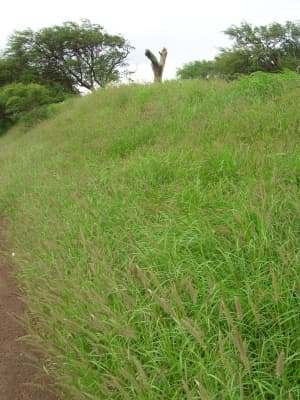
Cenchrus polystachios
Cenchrus polystachios
Safety & Hazards
None known
Cultivation Details
A plant of the moist tropical zone, preferring lowland areas but also found at elevations up to 2,400 metres - it is rarely found growing outside the tropical region. It grows best in areas where annual daytime temperatures are within the range 32 - 35°c, but can tolerate 12 - 40°c[1]. It prefers a mean annual rainfall in the range 1,000 - 2,000mm, but tolerates 750 - 3,000mm[1]. Grows best in a sunny position or in light shade[1], though it has persisted when growing under 80% shade[2]. It succeeds in a wide range of soils, preferring sandy soils and tolerating low fertility[2, 1]. It succeeds in highly phosphate-deficient nigrescent soils in Fiji[2]. Prefers a pH in the range 5 - 6.5, tolerating 4.4 - 8.5[1]. Established plants are tolerant of short-term seasonal inundation, and also of drought[1]. Originally native from Africa to India, the plant has spread through human activity and has become naturalized in many other areas of the tropics. It is declared a noxious weed in some areas[3]. The spreads are light and fluffy, they are spread readily by wind, attachment to animals, clothing etc. They also survive the annual burning that occurs in some areas - they then germinates rapidly and can smother other seedling plants. As a fire disclimax, it becomes the dominant species in a good deal of the mountainous land in Thailand and Fiji[2]. It causes major problems in the Northern Territory of Australia, where it has greatly increased the amount of flammable material in the wooded savannah ecosystem, leading to greater devastation from bushfires[4]. Dry matter yields may be between 5 - 10 tonnes per hectare[1].
Propagation
Seed - surface sow in situ and then roll the soil to firm the seed. Seed can also be sown in a nursery seedbed and then transplanted[2]. The seed has no dormancy and can germinate whilst still on the plant in very wet weather[2]. Cite as: Tropical Plants Database, Ken Fern. tropical.theferns.info. 2026-02-20. <tropical.theferns.info/viewtropical.php?id=Cenchrus+polystachios>
Pollinators
Wind
References
- [1]Ecocrop — http://ecocrop.fao.org/ecocrop/srv/en/home ↩︎Basic information on a wide range of useful plants, plus details of environmental needs where available.
- [2]Grassland Species - Profiles — http://www.fao.org/ag/AGP/AGPC/doc/Gbase/Default.htm ↩︎Terse information on over 650 species of plants that grow in grassland, including trees, shrubs and perennial plants as well as grasses. Gives a brief description of the plant, its range and habitat and some of its uses.
- [3]Pacific Island Ecosystems at Risk — http://www.hear.org/pier/scientificnames/index.html ↩︎A very good website detailing weed species that have been introduced into the Pacific Islands.
- [4]Global Invasive Species Database — http://www.issg.org/database/welcome/ ↩︎Very detailed information on almost 400 species (with more being added) of plants that have become weeds in areas outside their native range.