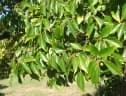
Celtis africana
Celtis africana
Safety & Hazards
The pollen has been recorded as an allergen[1].
Cultivation Details
A plant of the tropics and subtropics. It can tolerate some frost[1]. Although it prefers relatively fertile and deep moist soils, it can also be found on sandy dunes and river banks, as well as on rocky soils, but under these conditions it usually only develops into a shrub[1]. Requires a well-drained soil[1]. Established plants are moderately drought resistant[1]. A fast-growing plant with annual increases in height of 1 - 2 metres when young[1]. The first fruits may appear when trees are 4 years old[1]. The bark has a high content of phenolic compounds, deterring porcupines from damaging the bark[1].
Propagation
Seed - Fresh seeds germinate within 60 days and may have a high germination rate. Treatment is not necessary, but germination is hastened by soaking stones in cold water for 24 hours before sowing. They can be stored for some time in airtight containers. In South Africa seeds are sown in flat seedling trays filled with a mixture of 5 parts river sand and 1 part well decomposed compost placed in a warm but shaded place. To promote germination, seeds should be covered with a thin layer of river sand and kept moist; under these circumstances germination takes 15 - 30 days with a germination rate up to 70%. It is recommended to transplant seedlings into fertile soil. They should be watered sparingly[1]. Cite as: Tropical Plants Database, Ken Fern. tropical.theferns.info. 2026-02-20. <tropical.theferns.info/viewtropical.php?id=Celtis+africana>
Pollinators
Bees
References
- [1]Protabase - Plant Resources of Tropical Africa. — http://www.prota.org ↩︎An excellent on-line database with detailed information on over 3,200 species of useful plants of Africa.
- [2]Flora Zambesiaca — http://apps.kew.org/efloras/fz/intro.html ↩︎An excellent online flora of plants from the Zambezi River basin. It lists a number of the plant uses as well as the habitats and botanical descriptions of the plants.
- [3]Field Guide to the Moist Forest Trees of Tanzania. — Lovett J.C.; Ruffo C.K.; Gereau R.E.; Taplin J.R.D · Frontier · http://www.york.ac.uk/res/celp/webpages/projects/ecology/tree%20guide/introduction.htm · ISBN 1-873070-33-0 ↩︎A lovely little book giving a basic identification guide to more than 650 species of trees growing in Tanzania. It is also available to view on the internet.
- [4]Dictionary of Economic Plants. — Uphof. J. C. Th. · Weinheim · 1959 · ISBN - ↩︎An excellent and very comprehensive guide but it only gives very short descriptions of the uses without any details of how to utilize the plants. Not for the casual reader.