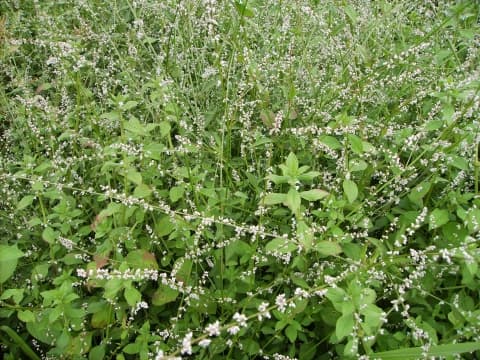
Celosia trigyna
Celosia trigyna
Safety & Hazards
None known
Cultivation Details
Plants grow best in moist tropical and subtropical areas at elevations up to 1,500 metres[1]. They requires up to 2,500 mm annual rainfall and grow best with temperatures of 25 - 30°c[1]. They are intolerant of temperatures below 15°c[1]. For best leaf production, the plant requires a fertile, moisture-retentive but well-drained soil in a sunny sheltered position[2, 3], though it is tolerant of a range of soil types[3]. The first leaf harvest is about 8 weeks after sowing and up to 8 pickings of young shoots are possible in a period of 2 months before flowering reduces growth[1]. Cutting of side branches and stems at 5 cm above soil level encourages branching[1]. Plants take 90 - 120 days from sowing to seed maturity[1].
Propagation
Seed - sow in situ. The seed germinates freely 4 - 5 days after sowing[1]. Cite as: Tropical Plants Database, Ken Fern. tropical.theferns.info. 2026-02-20. <tropical.theferns.info/viewtropical.php?id=Celosia+trigyna>
Pollinators
Insects
References
- [1]Protabase - Plant Resources of Tropical Africa. — http://www.prota.org ↩︎An excellent on-line database with detailed information on over 3,200 species of useful plants of Africa.
- [2]The New RHS Dictionary of Gardening. 1992. — Huxley. A. · MacMillan Press · 1992 · ISBN 0-333-47494-5 ↩︎Excellent and very comprehensive, though it contains a number of silly mistakes. Readable yet also very detailed.
- [3]Vegetables in the Tropics — Tindall. H. D. · MacMillan, Oxford. · 1983 · ISBN 0-333-24268-8 ↩︎An excellent, in-depth look at the main vegetable crops that can be grown in the Tropics, plus many less well-known plants.
- [4]Traditional Vegetables in Benin — Achigan-Dako E. Et al · Darwin Initiative; International Foundation for Science · 2009 ↩︎Issued as a PDF on the Internet, it contains basic information on over 250 species of plants used for food in Benin.
- [5]Flora Zambesiaca — http://apps.kew.org/efloras/fz/intro.html ↩︎An excellent online flora of plants from the Zambezi River basin. It lists a number of the plant uses as well as the habitats and botanical descriptions of the plants.
- [6]Dictionary of Economic Plants. — Uphof. J. C. Th. · Weinheim · 1959 · ISBN - ↩︎An excellent and very comprehensive guide but it only gives very short descriptions of the uses without any details of how to utilize the plants. Not for the casual reader.