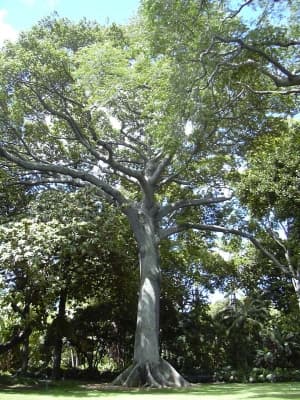
Ceiba pentandra
Ceiba pentandra
Safety & Hazards
The seeds, and the oil, contain cyclopropenoid fatty acids such as malvalic acid (7 - 8%) and sterculic acid (3%), which cause abnormal physiological reactions in animals. Therefore the consumption of kapok seeds or seed oil should be discouraged unless the cyclopropenoid acids have been chemically removed[1]. Kapok fibre is irritating to the eyes, nose and throat, and workers exposed to kapok dust for long periods may develop chronic bronchitis[1].
Cultivation Details
A plant of the moist tropics, where it is found at elevations up to 1,200 metres, though productivity starts to decline above 460 metres[2]. It grows best in areas where annual daytime temperatures are within the range 17 - 38°c, but can tolerate 12 - 40°c[3]. It can be killed by temperatures of -1°c or lower[3]. Fruiting can fail if the night temperature falls much below 20°c[4]. It prefers a mean annual rainfall in the range 1,500 - 2,500mm, but tolerates 750 - 5,700mm[3], 793. It can tolerate a dry season from 0 - 6 months long[2]. It is believed that the tree originated in central America, but it can now be found pantropically between 16 degrees north and 16 degrees south[5]. Kapok is the tallest native tree growing in Africa[6]. Prefers a sunny position in a fertile, deep, moisture-retentive but well-drained loamy soil[6, 7]. Prefers a pH in the range 5.5 - 6.5, tolerating 5 - 7.5[3]. Prefers a position sheltered from strong winds[7]. A fast-growing tree, the annual increases in height and diameter during the first 10 years are about 120cm and 3 - 4cm respectively[1]. In forest gaps height growth may be 2 metres per year[1]. The tree can begin to bear seeds, and therefore fibre, from the age of 4 - 5 years, with yields increasing up to about 8 years[3]. The economical life of the plants is about 60 years[3]. Leafing and flowering periods are more regular in drier parts of the distribution area; in moister areas, leafing and flowering periods are highly irregular[1]. The flowers open at night and are senescent by midday. They emit a powerful odour and secrete nectar at the base of the large, bisexual flowers[1, 5]. The fruits ripen 80 - 100 days after flowering, the dehiscent types releasing kapok with loosely embedded seeds that are wind-dispersed[1]. A single tree can bear 300 - 400 pods a year, yielding up to 20 kilos of fibre from about the age of 5 for over 50 years[7]. The tree responds well to coppicing[2]. The trees have vigorous rooting systems and are known to cause damage to buildings and roads if planted too close[2]. Cultivated kapok is believed to be a natural hybrid between two varieties respectively native of tropical America and West Africa[3]. The light seeds are widely disseminated and find ideal conditions for germination in abandoned agricultural land[5].
Propagation
Seed - sown as soon as ripe[7]. Without any pre-treatment seeds germinate slowly (less than 10% one month after sowing) and germination may continue for 3 - 4 months[1]. In the wild, a bush fire may cause simultaneous germination of the seeds[1]. Seedling growth is relatively fast, they can be 29cm tall after 6 weeks and 63cm after 51 weeks[1]. Cuttings of half-ripe wood[7]. Cuttings of long stems, 1.2 - 2 metres long are used commercially in the tropics[7]. These are placed direct into the open ground[7]. Cite as: Tropical Plants Database, Ken Fern. tropical.theferns.info. 2026-02-20. <tropical.theferns.info/viewtropical.php?id=Ceiba+pentandra>
Pollinators
Bats, Moths, Bees
References
- [1]Protabase - Plant Resources of Tropical Africa. — http://www.prota.org ↩︎An excellent on-line database with detailed information on over 3,200 species of useful plants of Africa.
- [2]Ceiba pentandra (L.) Gaertn. Ceiba, Kapok, silk cotton tree. Bombacaceae. Bombax family. — Chinea-Rivera J.D. · USDA Forest Service; New Orleans. · 1990 · http://www.treesearch.fs.fed.us/pubs/30402 ↩︎A very detailed article on Ceiba pentandra. It can be downloaded from the internet.
- [3]Ecocrop — http://ecocrop.fao.org/ecocrop/srv/en/home ↩︎Basic information on a wide range of useful plants, plus details of environmental needs where available.
- [4]Trees Commonly Cultivated in SE Asia — Jensen. M. · FAO Regional Office, Bangkok. · 1999 · ISBN 974-89377-5-5 ↩︎
- [5]World Agroforesty Centre — http://www.worldagroforestry.org/ ↩︎An excellent online database of a huge range of trees giving very good information on each plant - its uses, ecology, identity, propagation, pests etc.
- [6]The New RHS Dictionary of Gardening. 1992. — Huxley. A. · MacMillan Press · 1992 · ISBN 0-333-47494-5 ↩︎Excellent and very comprehensive, though it contains a number of silly mistakes. Readable yet also very detailed.
- [7]Encyclopaedia of Herbs and their Uses. — Bown. D. · Dorling Kindersley, London. · 1995 · ISBN 0-7513-020-31 ↩︎A very well presented and informative book on herbs from around the globe. Plenty in it for both the casual reader and the serious student. Just one main quibble is the silly way of having two separate entries for each plant.
- [8]A Taxonomic Revision of the Genus Ceiba — Gibbs P.; Semir J. · Anales del Jardín Botánico de Madrid · 2003 · http://dialnet.unirioja.es/servlet/fichero_articulo?codigo=762476&orden=78027 ↩︎A new treatment of the genus, which includes species previously in Chorisia. Available as a PDF file on the Internet.
- [9]Cornucopia II — Facciola. S. · Kampong Publications, California. · 1998 · ISBN 0-9628087-2-5 ↩︎The second edition of an excellent guide to the edible uses of plants, though it does not give any details of cultivation etc.
- [10]Medicinal Plants of the Guianas — DeFilipps, R. A.; Maina, S. L.; & Crepin, J. · Smithsonian Museum · http://botany.si.edu/bdg/medicinal/index.html ↩︎A down-loadable PDF document of a book in pre-publication awaiting illustration. An excellent, if rather terse, guide to the traditional medicinal uses of the plants of the region
- [11]Medicinal Plants of Brazil — Mors W.B.; Rizzini C.T.; Pereira N.A. · Reference Publications; Michigan. · 2000 · ISBN 0-917256-42-5 ↩︎An extremely concise book, listing approximately 1,500 species and varieties of plants with their botanical name, common name in Brazil, regions in Brazil where the plant is found, a brief list of uses and any medically active compounds in the plant.
- [12]Dictionary of Economic Plants. — Uphof. J. C. Th. · Weinheim · 1959 · ISBN - ↩︎An excellent and very comprehensive guide but it only gives very short descriptions of the uses without any details of how to utilize the plants. Not for the casual reader.
- [13]Tropix 7 — CIRAD · http://tropix.cirad.fr/en ↩︎An on-line guide to the timbers of 245 species of trees.