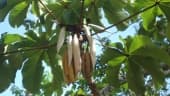
Cecropia glaziovii
Cecropia glaziovii
Safety & Hazards
The branches and leaf petioles of Cecropia species are often hollow and can harbour stinging ants. The trees attract the ants by means of producing a honey-like sap and the ants respond by working to keep the tree free of leaf-eating pests - which can include humans[1].
Cultivation Details
Plants in this genus generally prefer a sunny position in a well-drained soil[2]. A fast-growing, but short-lived tree[2]. It can reach its maximum height within 10 years[3]. A dioecious species, both male and female forms need to be grown if fruit and seed are required.
Propagation
Seed - requires light to germinate. It can be sown in light shade in a nursery seedbed, but should not be covered, just lightly pressed into the soil[3]. A reasonable germination rate can be expected, with the seeds sprouting within 3 - 4 weeks[3]. Greenwood cuttings in a frame with bottom heat. Cite as: Tropical Plants Database, Ken Fern. tropical.theferns.info. 2026-02-20. <tropical.theferns.info/viewtropical.php?id=Cecropia+glaziovii>
Pollinators
Data unavailable
References
- [1]Raintree Nutrition - Tropical Plant Database — http://www.rain-tree.com/plants.htm ↩︎Detailed information on the medicinal uses of more than two hundred rainforest plants, mainly from S. America, with basic descriptions of the plants, their other uses etc.
- [2]The New RHS Dictionary of Gardening. 1992. — Huxley. A. · MacMillan Press · 1992 · ISBN 0-333-47494-5 ↩︎Excellent and very comprehensive, though it contains a number of silly mistakes. Readable yet also very detailed.
- [3]Brazilian Trees. Volume 2. 4th Edition. — Lorenzi. H. · Instituto Plantarum De Estudos Da Flora; Brazil. · 2002 · ISBN 85-86714-15-1 ↩︎Information on 350 species of Brazilian trees. Stunning photographs of each species, brief details on the plant, its uses and how to grow it from seed. A superb work, with the minor irritation that the translation from Portuguese is not of the best.
- [4]Flora of Guatemala — Standley P.C. & J. A. Steyermark · 1946 - 1976 · http://www.archive.org/ ↩︎A superb reference, though somewhat dated. Gives lots of plant uses as well as information on plant habit and habitat. The entire flora (13 volumes) can now be downloaded from http://www.archive.org/