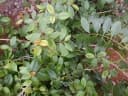
Catha edulis
Catha edulis
Safety & Hazards
None known
Cultivation Details
Khat is cultivated in highland areas of the tropics and subtropics at elevations of 1,500 - 2,500 metres[1]. In these areas the average daily temperatures are around 16 - 22°c (within a total range of 6 - 32°c). The annual rainfall requirements are 800 - 1,000 mm over a period of 4 - 6 months[1]. Frost and high humidity are growth-limiting factors[1]. Khat can be grown in a wide range of moderately acid to alkaline soils, from sandy loams to heavy clays, sufficiently deep and well drained, with a high organic matter content in the topsoil[1]. It is not salt tolerant[1]. Khat is predominantly a smallholder crop; farmers intercrop young khat plants with food crops during the first 5 - 6 years, after which shade from the trees becomes too heavy for intercropping. A mixed cropping system of a few rows of khat alternated with one or two rows of coffee (Coffea arabica L.) is not uncommon in Ethiopia[1]. Khat is left to grow undisturbed for 3 - years, until about 0.8 - 1 metre tall. Most leaves are then removed to induce the development of young shoots for a first light harvest. Normal yield levels are reached at 5 - 8 years after planting. The height of plants is maintained at 2.5 - 5 metres by regular pruning. Trees can be rejuvenated by cutting back all stems close to ground level and allowing emerging suckers to develop into new stems[1]. In this way plantations can be kept productive for 50 - 75 years without replanting[1]. Flowering generally occurs during the rainy season, the fruits maturing within 4 months[1]. Khat is often grown for home or local consumption and only harvested when the need arises. Such khat plots are not very productive. In market-oriented khat producing regions of Yemen and Ethiopia, yields can be as high as 2 tonnes of fresh shoots per hectare per year for well-managed orchards. Average annual yields in Ethiopia are reported to be 800 - 1,000 kg/ha[1]. The genus Catha consists of one highly polymorphic species within which there are several cultivated forms[1]. In Ethiopia, farmers distinguish several cultivars, including 'Dallota' with small pale green leaves, 'Dimma' with medium-sized red leaves and 'Mohedella' with green to olive-green leaves. In Yemen, khat cultivars are sometimes named after a location, e.g. 'Sabri', 'Reimi', 'Taizi' and 'Mathani', or their coloration[1].
Propagation
Seed - best sown as soon as it is ripe since it quickly loses its viability[1]. Fresh seeds germinate within 15 - 20 days[1]. Nearly all propagation is by cuttings taken from orthotropic (alternate-leaved) shoots. Growth of rooted cuttings starts with the emergence of new orthotropic shoots with reddish bark and alternate leaves from buds above the leaf axils. These stems continue to increase in length for some two years before the first lateral branches with plagiotropic growth appear from the axils of the oldest leaves, bearing slightly smaller opposite leaves[1]. Suckers develop at the base of stems in response to heavy pruning[1]. Cite as: Tropical Plants Database, Ken Fern. tropical.theferns.info. 2026-02-20. <tropical.theferns.info/viewtropical.php?id=Catha+edulis>
Pollinators
Data unavailable
References
- [1]Protabase - Plant Resources of Tropical Africa. — http://www.prota.org ↩︎An excellent on-line database with detailed information on over 3,200 species of useful plants of Africa.
- [2]Flora Zambesiaca — http://apps.kew.org/efloras/fz/intro.html ↩︎An excellent online flora of plants from the Zambezi River basin. It lists a number of the plant uses as well as the habitats and botanical descriptions of the plants.