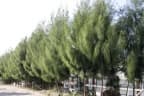
Casuarina oligodon
Casuarina oligodon
Safety & Hazards
None known
Cultivation Details
This is truly a tropical highland species, being found at elevations up to 2,500 metres or sometimes even higher[1]. It grows in areas where the mean annual rainfall is in the range 1,900 - 2,600 mm, there is a high relative humidity throughout the year with a weak dry season of up to 2 months and the temperatures vary from 11 - 15°c minimum at night to 24 - 30°c maximum during the day[1]. Prefers a sunny position[2]. Mostly found in sandy soils along creeks and rivers in the wild, but also grows well in colluvial soils, humic brown clay soils, alluvial and meadow soils[1]. Prefers a pH in the range 5.5 - 6.5, tolerating 4.5 - 7.5[2]. For use as fence posts, a rotation length of 12 - 15 years is sufficient with thinnings at age 6 which could be utilized as fuel wood etc[1]. According to Johnson (1982), the species consists of two subspecies: subsp. Oligodon and subsp. Abbreviata Subsp. Oligodon has longer leaves, up to 1mm long. It is used locally in the eastern highlands of Papua New Guinea[3] Subsp. Abbreviata has shorter leaves up to 0.5mm long. It is used to restore soil fertility and control soil erosion in the N Baliem valley of Irian Jaya[3]. This species has a symbiotic relationship with certain soil micro-organisms, these form nodules on the roots of the plants and fix atmospheric nitrogen. Some of this nitrogen is utilized by the growing plant but some can also be used by other plants growing nearby[1].
Propagation
Seed - sow in seed beds[1]. Germination usually starts after 10 days, though viability is naturally low[1]. Pricking out is carried out when the seedlings are about 50 - 60 mm high and are ready for transplanting into polythene tubes[1]. Seed production by the species is very good. Storage is mainly in household refrigerators where they are kept until needed for sowing[1]. No research has been carried so far into their longevity under these conditions, but appears to be orthodox for this family[1]. Cite as: Tropical Plants Database, Ken Fern. tropical.theferns.info. 2026-02-20. <tropical.theferns.info/viewtropical.php?id=Casuarina+oligodon>
Pollinators
Wind
References
- [1]World Agroforesty Centre — http://www.worldagroforestry.org/ ↩︎An excellent online database of a huge range of trees giving very good information on each plant - its uses, ecology, identity, propagation, pests etc.
- [2]Ecocrop — http://ecocrop.fao.org/ecocrop/srv/en/home ↩︎Basic information on a wide range of useful plants, plus details of environmental needs where available.
- [3]Mansfeld's Database of Agricultural and Horticultural Plants — http://mansfeld.ipk-gatersleben.de/pls/htmldb_pgrc/f?p=185:3:4292127278597336 ↩︎Terse details of a huge range of useful plants.