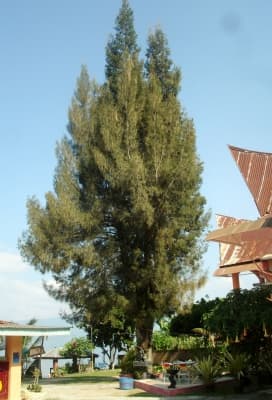
Casuarina junghuhniana
Casuarina junghuhniana
Safety & Hazards
None known
Cultivation Details
A plant of fairly moist tropical areas, usually found at higher elevations above 1,500 metres and as high as 3,100 metres, though it can succeed almost at sea level[1]. Rainfall in its natural habitat is monsoonal, with a well-defined summer maximum and a reported annual range of 700 - 1,500 mm[1]. The mean maximum temperature of the hottest month ranges from 25 - 28°c, whilst the mean minimum temperature of the coldest month ranges from 19 - 22°c[1]. Succeeds on a wide range of soils, from light volcanic and sandy soils to heavy clays[1]. It is tolerant of a wide pH range, from 2.8 in acidic clays to 8.0 in limestone-derived soils[1]. Established plants are drought-tolerant and can also survive prolonged periods of waterlogging[1]. Plants growing in a plantation have shown tolerance of saline soil conditions[1]. A fast growing species, seedlings can grow 3 metres per year for their first 2 - 3 years after planting out[1]. Once trees reach a few metres in height they are fire resistant and resprout readily after being damaged by fire[1]. Weeding is necessary only during the first few years, after which the trees shed large amounts of branchlets to form a thick and dense mat of litter that suppresses weeds[1]. Trees respond well to coppicing and pollarding[1]. They produce strong root suckers[1]. Trees are poor self-pruners, manual pruning in plantations up to a height of 2 - 2.5 metres is often necessary to make the plantations more accessible for general maintenance[1]. Plantation-grown trees can be harvested throughout the year. In Thailand, a harvesting cycle of 5 years is used for poles and fuel wood[1]. A mean annual increment of 10 - 15 cubic metres per hectare is generally obtainable[1]. The plant fixes atmospheric nitrogen by nodulation with actinomycete bacteria of the genus Frankia. The nodules are woody and perennial and can form large masses in the root system[1].
Propagation
Seed - Mature seeds germinate readily without pre-treatment. Germination is good and uniform, completed after 10 days. The germination rate is 50-60%, decreasing rapidly unless kept in dry cool storage. Propagation is by seed, shoot cuttings or air layering. Seed is sown onto germination beds. Seedlings are pricked out into polythene bags when 3-5 cm tall. For mass propagation, shoot cuttings are more suitable than air layering. Under favourable conditions seedlings attain 25-30 cm in height within 3 months. Inoculation of the seedlings or cuttings with effective strains of Frankia bacteria is recommended when C. junghuhniana is introduced into a new area Seed storage behaviour is orthodox; can keep viability for up to 1 year at room temperature. 1-1.8 million seeds/kg Cite as: Tropical Plants Database, Ken Fern. tropical.theferns.info. 2026-02-20. <tropical.theferns.info/viewtropical.php?id=Casuarina+junghuhniana>
Pollinators
Wind
References
- [1]World Agroforesty Centre — http://www.worldagroforestry.org/ ↩︎An excellent online database of a huge range of trees giving very good information on each plant - its uses, ecology, identity, propagation, pests etc.