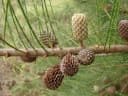
Casuarina glauca
Casuarina glauca
Safety & Hazards
There is a report that the pollen might be allergenic[1].
Cultivation Details
Casuarina glauca grows best at elevations lower than 900 metres[2]. It is reported to tolerate an annual precipitation in the range of 500 to 4,000mm, estimated annual temperature range of 18 to 28°c, and a pH of 5 to 8[1]. Plants have grown in Israel under a soil crust of salt (50,000 ppm)[1]. The plant rarely tolerates temperatures lower than -3°c[1]. Coastal plants do not experience frost, but inland there can be 1 - 5 frosts per year[3]. Requires a well-drained moisture-retentive soil in full sun[4]. Succeeds in most soils in Australian gardens, including saline ones, and is tolerant of salt spray[5, 6, 1]. Plants are reported to tolerate high pH, limestone soils, low pH, salt and sand dunes, sea spray, periodic water-logging, drought, weeds, and wind[1, 2]. In fine-textured clays, even in waterlogged soils, it can develop a deep root system[2]. Plants coppice and produce root suckers vigorously[2]. Spreading by means of root suckers, this species has become a pest in some parts of Florida[1]. Closely related to Casuarina cunninghamiana, though somewhat less hardy[1], it often hybridises in the wild with that species[7]. In fine-textured clays, even in waterlogged soils, this species can develop a deep root system, whilst Casuarina cunninghamiana and Casuarina equisetifolia develop shallow roots and grow poorly[1]. A dioecious species, both male and female plants need to be grown if seed is required[8]. The male flowers are produced on terminal spikes, the females in cone-like structures[9]. This species has a symbiotic relationship with certain soil micro-organisms, these form nodules on the roots of the plants and fix atmospheric nitrogen. Some of this nitrogen is utilized by the growing plant but some can also be used by other plants growing nearby[5]. Although Nitrogen nodulation is most successful at Ph 6 to 8, some natural stands are well nodulated in acid soils (Ph 4)[1]. Inoculation of seedlings with pure culture of effective strains of Frankia rhizobia is recommended when introducing the species to new areas[2].
Propagation
Seed - the optimum temperature for germination is 30°c[2]. Sow late winter to early summer in a greenhouse and only just cover the seed[10]. When they are large enough to handle, prick the seedlings out into individual pots and grow them on in a greenhouse for at least their first winter. Plant them out into their permanent positions in late spring or early summer, after the last expected frosts. There are 440,000 - 550,000 seeds per kilo[1]. Cuttings of half-ripe wood, mid summer in a frame[5, 4]. Treatment of terminal branchlets, heel cuttings or basal sprouts especially from juvenile plants with root-inducing hormone powder has proved successful[2]. Cuttings should be maintained on a mist bench with bottom heat[2]. Vegetative propagation by air layering has been attempted with limited success[2]. Cite as: Temperate Plants Database, Ken Fern. temperate.theferns.info. 2026-02-20. <temperate.theferns.info/plant/Casuarina+glauca>
Pollinators
Wind
References
- [1]Handbook of Energy Crops — Duke. J. · - · 1983 · https://hort.purdue.edu/newcrop/duke_energy/dukeindex.html · ISBN - ↩︎Published only on the Internet, excellent information on a wide range of both temperate and tropical plants.
- [2]World Agroforesty Centre — http://www.worldagroforestry.org/ ↩︎An excellent online database of a huge range of trees giving very good information on each plant - its uses, ecology, identity, propagation, pests etc.
- [3]Australian Trees and Shrubs: Species for Land Rehabilitation and Farm Planting in the Tropics — Doran J.C.; Turnbull J.W. (Editors) · Australian Centre for International Agricultural Research; Canbe · 1997 · ISBN 1-86320-127-0 ↩︎A very informative book, rich in information about the uses, cultivation needs and very much more for over 160 species of Australian trees and shrubs.
- [4]The New RHS Dictionary of Gardening. 1992. — Huxley. A. · MacMillan Press · 1992 · ISBN 0-333-47494-5 ↩︎Excellent and very comprehensive, though it contains a number of silly mistakes. Readable yet also very detailed.
- [5]Australian Native Plants. — Wrigley. J. W. and Fagg. M. · Collins. (Australia) · 1988 · ISBN 0-7322-0021-0 ↩︎A lovely book, written in order to encourage Australian gardeners to grow their native plants. A little bit of information for the plant project.
- [6]A Field Guide to Australian Trees. — Holliday. I. and Hill. R. · Frederick Muller Ltd. · 1974 · ISBN 0-85179-627-3 ↩︎A well illustrated and very readable book, but it does not contain much information for the plant project.
- [7]Flora of the Sydney Region — Carolin. R. & Tindale. M. · Reed. Australia. · 1993 · ISBN 0730104001 ↩︎Concise flora with little beyond an extensive key, species descriptions, very brief habitat description.
- [8]Flora of Australia — http://www.anbg.gov.au/abrs/abif/flora/ ↩︎The full information from the Flora of Australia - on-line. An excellent resource.
- [9]Plant Resources of Southeast Asia — http://proseanet.org/ ↩︎Lots of information on the uses of the plants of SE Asia.
- [10]Growing from Seed. Volume 3. — Bird. R. (Editor) · Thompson and Morgan. · 1989 · ISBN - ↩︎Very readable magazine with lots of information on propagation.
- [11]Useful Wild Plants in Australia. — Cribb. A. B. and J. W. · William Collins Pty Ltd. Sidney · 1981 · ISBN 0-00-216441-8 ↩︎A very readable book.
- [12]Plants for Human Consumption. — Kunkel. G. · Koeltz Scientific Books · 1984 · ISBN 3874292169 ↩︎An excellent book for the dedicated. A comprehensive listing of Latin names with a brief list of edible parts.
- [13]The Useful Native Plants of Australia. — Maiden J.H. · Turner & Co.; London. · 1889 · http://www.biodiversitylibrary.org ↩︎Terse details of the uses of many Australian plants and other species naturalised, or at least growing, in Australia. It can be downloaded from the Internet.
- [PFAF]Plants for a Future — pfaf.org ↩︎