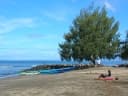
Casuarina equisetifolia
Casuarina equisetifolia
Safety & Hazards
None known
Cultivation Details
Casuarina equisetifolia is adaptable to a wide range of conditions, being found from the semi-arid to subhumid tropics and subtropics, usually near sea level but succeeding under cultivation at heights up to 1,400 metres[1, 2]. It grows best in areas where the mean annual temperature is in the range 10 - 35°c and prefers a mean annual rainfall in the range 700 - 2,000mm, though it tolerates 200 - 3,500mm[1, 2]. In most areas where it grows there is a distinct dry period of 4 - 6 months, although this seasonality decreases towards the equator in Southeast Asia and in the southern parts of its range in Australia[1]. Requires a sunny position and a well-drained soil[1, 3]. Prefers alkaline to neutral soils[2]. Prefers a pH in the range 5 - 6.5, but tolerates 4 - 8.5[4]. Plants are very resistant to salt spray and can also tolerate occasional inundation by sea water at extremely high tides[1]. Young plants are susceptible to drought until their roots reach the groundwater table, which may take up to 2 - 3 years after planting[1], but then they become very drought resistant[3]. Casuarina equisetifolia is a fast growing species with prolific seeding ability which is able to take advantage of disturbed sites for colonization. Where it establishes it may form dense, low biodiversity stands with negative impacts on native flora, fauna, soil character and dynamics. It is reported to be invasive in a number of countries and is a particular problem in Florida and South Africa, and is said to be invasive in many other countries including Brazil and the Caribbean[5]. This species can flower and produce fruit all year round[6]. Common ru has a life span of 40 - 50 years and displays fast early growth. Under favourable conditions, early growth rates are about 2 metres per year. On favourable sites, it can yield an annual increment of 15 cubic metres per hectare of wood in 10 years[1]. In South China, where an estimated 1 million hectares in shelterbelts along the coastal dunes have been established since 1954, heights of 7 - 8 metres and diameters of 5 - 7 cm are achieved in about 4 years[1]. The rotation period ranges from 4 - 5 years for fuel wood and 10 - 15 years for poles[1]. Common ru can be the only woody species growing over a ground cover of dune grasses and salt-tolerant broadleaved herbs; it can also be part of a richer association of trees and shrubs collectively termed the Indo-Pacific strand flora[1]. The tree is not fire resistant and protection is necessary[1]. The plant coppices only to a limited extent and best results are obtained when cut young[1]. Timely thinning is essential as Casuarina species trees demand light[1]. Young trees are susceptible to competition from weeds, especially grasses[1]. Although the tree is evergreen, it usually sheds a large amount of twigs throughout the year[7]. In Asia, leaf litter from plantations is often removed for use as fuel and this draws heavily upon soil phosphorus and potassium reserves. This can result in reduced yield in the subsequent rotation[1]. In cultivation, this species hybridizes with Casuarina glauca and Casuarina junghuhniana[1]. Root nodules containing the actinorhizal symbiont Frankia enable Casuarina equisetifolia to fix atmospheric nitrogen. These root nodules can be prolific[1]. The tree possesses proteoid roots and forms associations with vesicular arbuscular mycorrhizae[1]. This species can be monoecious or dioecious. Dioecious plants will require both male and female forms to be grown if fruit and seed are required[1, 2, 7].
Propagation
Seeds can be sown without pre-treatment but should be protected from ants[1]. Germination takes up to 2 weeks and is epigeal. Seedlings should be planted in well-drained light soils, not clay soils, to decrease the incidence of diseases and pests. Appropriate watering, correct spacing of plants and adequate light should check damping-off in the nursery. Seedlings can be pricked out when 3 - 10 cm tall and transferred to beds or containers. Plants are typically suitable for out-planting when 25 - 30 cm tall[1]. Storage behaviour is orthodox. Viability can be maintained for several years in hermetic storage at 3 deg. C with 5-9% mc. There are about 26000 seeds/kg but viability is often low, even for fresh seed, averaging 50% Cuttings are made from small branchlets 2 mm diameter and 10 - 15 cm length, and rooting is enhanced through the use of rooting hormone[1]. Air-layering is sometimes practised but is too costly for large-scale operations[1]. Cite as: Tropical Plants Database, Ken Fern. tropical.theferns.info. 2026-02-20. <tropical.theferns.info/viewtropical.php?id=Casuarina+equisetifolia>
Pollinators
Wind
References
- [1]World Agroforesty Centre — http://www.worldagroforestry.org/ ↩︎An excellent online database of a huge range of trees giving very good information on each plant - its uses, ecology, identity, propagation, pests etc.
- [2]Trees Commonly Cultivated in SE Asia — Jensen. M. · FAO Regional Office, Bangkok. · 1999 · ISBN 974-89377-5-5 ↩︎
- [3]Tropical and Subtropical Trees - A Worldwide Encyclopaedic Guide. — Barwick. M. · Thames & Hudson, London · 2004 · ISBN 0-500-51181-0 ↩︎A superb book, very concise and well written, giving a wealth of information on 400 or more species including descriptions, habitat, cultivation details and plant uses. A wealth of colour photographs bring each plant vividly to life.
- [4]Ecocrop — http://ecocrop.fao.org/ecocrop/srv/en/home ↩︎Basic information on a wide range of useful plants, plus details of environmental needs where available.
- [5]Invasive Species Compendium — http://www.cabi.org ↩︎An immense resource - in depth information on over 900 species of invasive plants (it also has information on animals, fungi etc).
- [6]Medicinal Plants in Papua New Guinea — World Health Organisation · 2009 · ISBN 978-92-9061-249-0 ↩︎Traditional medicinal uses of 126 species from Papua New Guinea, including information on modern research into the plants.
- [7]Digital Compendium of Forestry Species of Cambodia — www.digitalspecies.blogspot.com; Phnom Penh · 2008 · http://www.digitalspecies.blogspot.com ↩︎A very detailed booklet, produced in PDF format on the internet, giving information on around 100 species of trees.
- [8]Australian Trees and Shrubs: Species for Land Rehabilitation and Farm Planting in the Tropics — Doran J.C.; Turnbull J.W. (Editors) · Australian Centre for International Agricultural Research; Canbe · 1997 · ISBN 1-86320-127-0 ↩︎A very informative book, rich in information about the uses, cultivation needs and very much more for over 160 species of Australian trees and shrubs.
- [9]The Useful Native Plants of Australia. — Maiden J.H. · Turner & Co.; London. · 1889 · http://www.biodiversitylibrary.org ↩︎Terse details of the uses of many Australian plants and other species naturalised, or at least growing, in Australia. It can be downloaded from the Internet.