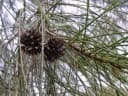
Casuarina cristata
Casuarina cristata
Safety & Hazards
None known
Cultivation Details
Casuarina cristata is a plant mainly of the warm temperate and subtropical zones, though it does just reach into the tropics. It is found at elevations up to 800 metres. It grows best in areas where annual daytime temperatures are within the range 24 - 34°c, but can tolerate 8 - 40°c[1]. Mature plants can be killed by temperatures of -5°c or lower, but young growth can be badly damaged at 0°c[1]. Up to 50 heavy frosts per year can occur within parts of its range[2]. It prefers a mean annual rainfall in the range 500 - 600mm, but tolerates 400 - 700mm[1]. The mean annual rainfall can range from 300 - 1,178mm[2]. Requires a well-drained moisture-retentive soil in full sun[3]. Succeeds in a wide range of soils in the wild, including heavy soils, waterlogged soils and somewhat alkaline or saline soils[2]. A report for Australian gardens says that it prefers growing in dry areas but can also thrive in very wet soils[4]. Prefers a pH in the range 6.5 - 8, tolerating 6 - 8.5[1]. A relatively fast growing tree that responds well to coppicing[4, 2]. The plant produces suckers from the roots and often forms dense groves which can be all of one clone[5, 6]. Unlike most members of this genus, this plant does not fix atmospheric nitrogen[3]. Another report says that it does have a symbiotic relationship with the nitrogen-fixing soil bacterium Frankia, and does fix atmospheric nitrogen[2]. This species is dioecious - both male and female plants must be grown if seed is required[6].
Propagation
Seed - sow late winter to early summer in a greenhouse and only just cover the seed[7]. The optimum germination temperature is 25°c[2]. When they are large enough to handle, prick the seedlings out into individual pots and grow them on in a greenhouse for at least their first winter. Plant them out into their permanent positions in late spring or early summer, after the last expected frosts. Cuttings of half-ripe wood, mid summer in a frame[4, 3]. Division of suckers. Cite as: Temperate Plants Database, Ken Fern. temperate.theferns.info. 2026-02-20. <temperate.theferns.info/plant/Casuarina+cristata>
Pollinators
Data unavailable
References
- [1]Ecocrop — http://ecocrop.fao.org/ecocrop/srv/en/home ↩︎Basic information on a wide range of useful plants, plus details of environmental needs where available.
- [2]Australian Trees and Shrubs: Species for Land Rehabilitation and Farm Planting in the Tropics — Doran J.C.; Turnbull J.W. (Editors) · Australian Centre for International Agricultural Research; Canbe · 1997 · ISBN 1-86320-127-0 ↩︎A very informative book, rich in information about the uses, cultivation needs and very much more for over 160 species of Australian trees and shrubs.
- [3]The New RHS Dictionary of Gardening. 1992. — Huxley. A. · MacMillan Press · 1992 · ISBN 0-333-47494-5 ↩︎Excellent and very comprehensive, though it contains a number of silly mistakes. Readable yet also very detailed.
- [4]Australian Native Plants. — Wrigley. J. W. and Fagg. M. · Collins. (Australia) · 1988 · ISBN 0-7322-0021-0 ↩︎A lovely book, written in order to encourage Australian gardeners to grow their native plants. A little bit of information for the plant project.
- [5]The Complete Trees of N. America. Field Guide and Natural History. — Elias. T. · Van Nostrand Reinhold Co. · 1980 · ISBN 0442238622 ↩︎A very good concise guide. Gives habitats, good descriptions, maps showing distribution and a few of the uses. It also includes the many shrubs that occasionally reach tree proportions.
- [6]Flora of Australia — http://www.anbg.gov.au/abrs/abif/flora/ ↩︎The full information from the Flora of Australia - on-line. An excellent resource.
- [7]Growing from Seed. Volume 3. — Bird. R. (Editor) · Thompson and Morgan. · 1989 · ISBN - ↩︎Very readable magazine with lots of information on propagation.
- [8]Useful Wild Plants in Australia. — Cribb. A. B. and J. W. · William Collins Pty Ltd. Sidney · 1981 · ISBN 0-00-216441-8 ↩︎A very readable book.