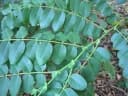
Cassia javanica
Cassia javanica
Safety & Hazards
None known
Cultivation Details
A plant of the lowland tropics and subtropics where it can be found at elevations up to 400 metres. It grows best in areas where the mean annual temperatures are within the range 19 - 25°c, and the mean annual rainfall is in the range 650 - 2,400mm[1]. Requires a sunny position[2]. The plant is found in a wide range of habitats, the various subspecies showing preferences for either dry or moist habitats on a wide variety of soils including fertile volcanic loams, and from marshy, sandy and limestone soils[1]. Established plants are drought tolerant[3]. A fast-growing species[2]. The plant is not resistant to fire[1]. This is a very polymorphic species with a wide distribution from N India through the Indochinese Peninsula and the Malesian region to New Guinea. Altogether, seven subspecies are recognized[4]. The subsp agnes (de Wit) K. Larsen is most commonly grown as an ornamental because of its larger flowers[1].
Propagation
Seed - scarifying the seed, or pre-soaking in warm water for 12 - 24 hours can improve germination rates. Germination rates of 20 - 70% have been recorded, with the seed taking from 5 days to 1 year to germinate[1]. Fresh seed can be stored for only 3 weeks in airtight containers, but storing dry seeds for over one year is also reported[1]. Cite as: Tropical Plants Database, Ken Fern. tropical.theferns.info. 2026-02-20. <tropical.theferns.info/viewtropical.php?id=Cassia+javanica>
Pollinators
Data unavailable
References
- [1]World Agroforesty Centre — http://www.worldagroforestry.org/ ↩︎An excellent online database of a huge range of trees giving very good information on each plant - its uses, ecology, identity, propagation, pests etc.
- [2]Digital Compendium of Forestry Species of Cambodia — www.digitalspecies.blogspot.com; Phnom Penh · 2008 · http://www.digitalspecies.blogspot.com ↩︎A very detailed booklet, produced in PDF format on the internet, giving information on around 100 species of trees.
- [3]Dominica Botanic Gardens — http://www.da-academy.org/trees_shrubs.html ↩︎An on-line resource, providing top quality pictures and some basic information on various plants being grown at the Botanic Gardens, often including uses and habitat.
- [4]Flora of China — Missouri Botanical Garden Press; St. Louis. · 1994 · http://flora.huh.harvard.edu/china/ ↩︎An excellent, comprehensive resource in 25 volumes. In addition to the botanical information the flora also gives basic information on habitat and some uses. An on-line version is also available.
- [5]IUCN Red List of Threatened Species — http://www.iucnredlist.org/ ↩︎A list of plants under threat and facing possible extinction, usually with brief details of the threats and information on habitat.
- [6]Mansfeld's Database of Agricultural and Horticultural Plants — http://mansfeld.ipk-gatersleben.de/pls/htmldb_pgrc/f?p=185:3:4292127278597336 ↩︎Terse details of a huge range of useful plants.