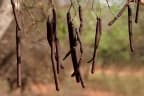
Cassia fistula
Cassia fistula
Safety & Hazards
None known
Cultivation Details
Plants succeed in the dry to moist tropics and subtropics, growing in areas where the annual rainfall is in the range 500 - 2,700 mm and the average annual temperatures is 18 - 29°c[1]. Plants are vulnerable to frost[1]. Prefers a deep, well-drained, moderately fertile sandy loam and a position in full sun[2]. It seems to favour calcareous and red, volcanic soils, but is also found on sandy and loamy soils with a pH of 5.5 - 8.7[1]. Tolerates some shade[1]. Established plants are fairly drought resistant[1, 3]. The plants are slow-growing and generally take 8 - 10 years from sowing to flowering[1]. This period can be reduced by vegetative propagation[1]. At the beginning of flowering, the whole crown is covered with flowers; sporadic flowering continues for up to 3 months[1]. The seeds take about a year to ripen[4]. The tree coppices well and produces root suckers freely[1]. It does not compete well with weeds[1]. Although it is a legume, the roots of this species lack nodulating ability and do not fix atmospheric nitrogen[1].
Propagation
Seed. The seeds have a hard seed coat and germination is improved by mechanical scarification or treatment with concentrated sulphuric acid for at least 45 minutes[1]. Pre-soaking for 12 - 24 hours in warm water can also be tried[PFAF]. The seed should be sown in full light, and adequate water supply is required for optimal germination - the seed can increase three times in weight by absorbing water[1]. Germination takes place within a few days[5]. Direct sowing is practised in Asia[1]. Seed can be stored for prolonged periods without loss of viability[1]. Cuttings of half ripe wood[2]. Cite as: Tropical Plants Database, Ken Fern. tropical.theferns.info. 2026-02-20. <tropical.theferns.info/viewtropical.php?id=Cassia+fistula>
Pollinators
Insects
References
- [1]Protabase - Plant Resources of Tropical Africa. — http://www.prota.org ↩︎An excellent on-line database with detailed information on over 3,200 species of useful plants of Africa.
- [2]The New RHS Dictionary of Gardening. 1992. — Huxley. A. · MacMillan Press · 1992 · ISBN 0-333-47494-5 ↩︎Excellent and very comprehensive, though it contains a number of silly mistakes. Readable yet also very detailed.
- [3]Trees of Laos and Vietnam - A Field Guide to 100 species. — Hoang Van Sam; Khamseng Nanthavong; Kessler P.J.A. · Blumea · 2004 ↩︎A detailed guide, with excellent line-drawings, to 100 of the more important trees of Laos and Vietnam. A very good work, giving lots of information about each plant. Originally published in the journal Blumea, it is available as a PDF on the Interne
- [4]Tropical and Subtropical Trees - A Worldwide Encyclopaedic Guide. — Barwick. M. · Thames & Hudson, London · 2004 · ISBN 0-500-51181-0 ↩︎A superb book, very concise and well written, giving a wealth of information on 400 or more species including descriptions, habitat, cultivation details and plant uses. A wealth of colour photographs bring each plant vividly to life.
- [5]World Agroforesty Centre — http://www.worldagroforestry.org/ ↩︎An excellent online database of a huge range of trees giving very good information on each plant - its uses, ecology, identity, propagation, pests etc.
- [6]Digital Compendium of Forestry Species of Cambodia — www.digitalspecies.blogspot.com; Phnom Penh · 2008 · http://www.digitalspecies.blogspot.com ↩︎A very detailed booklet, produced in PDF format on the internet, giving information on around 100 species of trees.
- [7]Trade in Indian Medicinal Plants — D.K.Ved, S.Noorunnisa Begum, & K.Ravi Kumar · Apple Academic Press; Oakville, Canada · 2018 · ISBN 978-1-77188-600-0 ↩︎
- [8]IUCN Red List of Threatened Species — http://www.iucnredlist.org/ ↩︎A list of plants under threat and facing possible extinction, usually with brief details of the threats and information on habitat.
- [9]Plant Resources of Southeast Asia — http://proseanet.org/ ↩︎Lots of information on the uses of the plants of SE Asia.
- [10]Cornucopia II — Facciola. S. · Kampong Publications, California. · 1998 · ISBN 0-9628087-2-5 ↩︎The second edition of an excellent guide to the edible uses of plants, though it does not give any details of cultivation etc.
- [11]The Useful Plants of the Island of Guam — Safford W.E. · Smithsonian Institute; Washington. · 1905 · http://www.biodiversitylibrary.org/ ↩︎A very comprehensive, if rather dated, guide to the plants of Guam. It can be downloaded from the Internet.
- [12]Medicinal Plants of the Guianas — DeFilipps, R. A.; Maina, S. L.; & Crepin, J. · Smithsonian Museum · http://botany.si.edu/bdg/medicinal/index.html ↩︎A down-loadable PDF document of a book in pre-publication awaiting illustration. An excellent, if rather terse, guide to the traditional medicinal uses of the plants of the region
- [13]Trees Commonly Cultivated in SE Asia — Jensen. M. · FAO Regional Office, Bangkok. · 1999 · ISBN 974-89377-5-5 ↩︎
- [PFAF]Plants for a Future — pfaf.org ↩︎