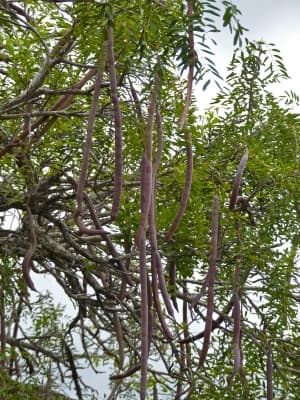
Cassia abbreviata
Cassia abbreviata
Safety & Hazards
None known
Cultivation Details
A plant of the seasonal tropics, where it can be found at elevations up to 1,000 metres[1]. It grows in areas where the mean annual rainfall is around 1,400mm[1]. It can withstand moderate frost according to some reports[2, 1], whilst another says that it is frost tender[3]. Prefers a sunny position in a deep sandy and well drained soil[3]. Established plants are drought tolerant[2, 1]. A moderately fast growing plant[2]. Relatively slow-growing[3]. The plant can be pollarded or coppiced[2]. The flowers are highly appreciated as bee forage[2]. Cassia abbreviata does not form nitrogen-fixing root nodules, yet it has a high nitrogen content in its leaves. It has been suggested that it may fix atmospheric nitrogen in a different way, in symbiosis with ectomycorrhizas[2].
Propagation
Seed - it has a hard seedcoat and may benefit from scarification before sowing to speed up germination. This can usually be done by pouring a small amount of nearly boiling water on the seeds (being careful not to cook them!) and then soaking them for 12 - 24 hours in warm water. By this time they should have imbibed moisture and swollen - if they have not, then carefully make a nick in the seedcoat (being careful not to damage the embryo) and soak for a further 12 hours before sowing. Treated seeds germinate 4 - 10 days after sowing. They are sown in a sand-compost mixture (1:1) and should be kept warm and moist. The seedlings quickly develop a tap root and so it is better not to use seeding trays, but to sow directly into polythene bags or into the ground[2]. Cite as: Tropical Plants Database, Ken Fern. tropical.theferns.info. 2026-02-20. <tropical.theferns.info/viewtropical.php?id=Cassia+abbreviata>
Pollinators
Data unavailable
References
- [1]World Agroforesty Centre — http://www.worldagroforestry.org/ ↩︎An excellent online database of a huge range of trees giving very good information on each plant - its uses, ecology, identity, propagation, pests etc.
- [2]Protabase - Plant Resources of Tropical Africa. — http://www.prota.org ↩︎An excellent on-line database with detailed information on over 3,200 species of useful plants of Africa.
- [3]PlantZAfrica.com — http://www.plantzafrica.com ↩︎An excellent site giving detailed descriptions and uses of many S. African plants.
- [4]Flora of Southern Africa — Roux J.P. · 2003 · http://plants.jstor.org/search?st=662545 ↩︎An excellent on-line resource.