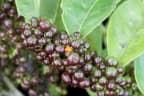
Casearia sylvestris
Casearia sylvestris
Safety & Hazards
The fruit is a capsute containing several seeds. Although the capsule of some species (and possibly also the seeds contained therein) is somewhat toxic, the fleshy aril surrounding the seeds is a different matter and in some species (see information below on edibility to see if this is one of them) is often eaten and is considered to be perfectly wholesome[1, PFAF].
Cultivation Details
Succeeds in full sun and in dappled shade[2]. Tolerant of salty soils[3]. A fast-growing plant, commencing flowering whan around 100cm tall[2, 4]. Plants can live around 20 years[4]. Plants usually respond well to coppicing[4]. The plant can flower and produce fruit all year round[5, 4]. The flowers smell like a mixture of honey and urine[4].
Propagation
The seed of species in this genus often has a short period of viability and so is best sown as soon as it is ripe. The seed is collected when the fruits start to open - leave them in the sun to open completely to release the seed, then rinse the seed in water to remove the arils[3]. Sow the seed in a partially shaded position in a nursery seedbed, only just covering the seed, and keep moist. Germination rates vary, but can usually be expected to be low, with the seed sprouting within 20 - 30 days[2]. When the seedlings are 3 - 5cm tall, pot them up into individual containers and they should be ready to plant out a few months later[2]. Cuttings. Cite as: Tropical Plants Database, Ken Fern. tropical.theferns.info. 2026-02-20. <tropical.theferns.info/viewtropical.php?id=Casearia+sylvestris>
Pollinators
Bees
References
- [1]Food Plants in the Americas: A Survey of the Domesticated, Cultivated, and Wild Plants Used for Human Food in North, — Kermath B.M.; Bennett B.C.' Pulsipher L.M. · 2014 ↩︎A pre-publication draft of an amazing, on-going work first started in 1985. It contains information on more than 3,900 taxa from the Americas - from Arctic regions to the Tropics
- [2]Brazilian Trees. Volume 1. 4th Edition. — Lorenzi. H. · Instituto Plantarum De Estudos Da Flora; Brazil. · 2002 · ISBN 85-86714-17-8 ↩︎Information on 350 species of Brazilian trees. Stunning photographs of each species, brief details on the plant, its uses and how to grow it from seed. A superb work, with the minor irritation that the translation from Portuguese is not of the best.
- [3]Iracambi Medicinal Plants — Gallia. E. · 2003 · http://www.iracambi.com/english/herbarium.shtml ↩︎Basic iInformation on 14 plants of the Atlantic Rainforest in Brazil.
- [4]Wildland Shrubs of the United States and its Territories: Thamnic Descriptions — Francis J.K. (Editor) · USDA; Forest Service International Institute of Tropical Forestr · 2000 · http://www.fs.fed.us/global/iitf/wildland_shrubs.htm ↩︎An excellent series of papers, in PDF format, from various authors giving quite detailed information on a range of shrubs growing in the United States and its Territories. It can be downloaded from the Internet.
- [5]Common Trees of Puerto Rico and the Virgin Islands — Little E.L.; Wadsworth F.H. · USDA, Forest Service; Washington. · 1964 ↩︎Contains detailed information, and usually an illustration, on 250 tree species, including both native and exotic species.
- [6]Flora of Guatemala — Standley P.C. & J. A. Steyermark · 1946 - 1976 · http://www.archive.org/ ↩︎A superb reference, though somewhat dated. Gives lots of plant uses as well as information on plant habit and habitat. The entire flora (13 volumes) can now be downloaded from http://www.archive.org/
- [7]Woods of Northeastern Peru — Williams L. · Field Museum Press; Chicago. · 1936 · http://www.biodiversitylibrary.org/ ↩︎Gives information on the properties of the wood of well over 1,000 species of woody plants from northeastern Peru. Can be downloaded from the Internet.
- [8]IUCN Red List of Threatened Species — http://www.iucnredlist.org/ ↩︎A list of plants under threat and facing possible extinction, usually with brief details of the threats and information on habitat.
- [9]Diccionario das Plantas Uteis do Brasil — Correa M.P. · Imprensa Nacional; Rio de Janeiro · 1926 ↩︎A massive work in 6 volumes giving details of the various uses of Brazilian plants.
- [10]Medicinal Plants of Brazil — Mors W.B.; Rizzini C.T.; Pereira N.A. · Reference Publications; Michigan. · 2000 · ISBN 0-917256-42-5 ↩︎An extremely concise book, listing approximately 1,500 species and varieties of plants with their botanical name, common name in Brazil, regions in Brazil where the plant is found, a brief list of uses and any medically active compounds in the plant.
- [11]Levantamento de plantas medicinais arbóreas e ocorrência em Floresta Ombrófila Mista — Pedroso K. et al · 2007 · ISBN 1808-0251 ↩︎
- [12]Dictionary of Economic Plants. — Uphof. J. C. Th. · Weinheim · 1959 · ISBN - ↩︎An excellent and very comprehensive guide but it only gives very short descriptions of the uses without any details of how to utilize the plants. Not for the casual reader.
- [13]Medicinal Plants of Asia and the Pacific — Wiart C. · CRC Press, Taylor & Francis Group; Florida. · 2006 · ISBN 0-8493-7245-3 ↩︎An excellent look at a range of plants, in particular focussing on the active principles that could be responsible for the medical activities.
- [14]CosIng — http://ec.europa.eu/growth/tools-databases/cosing/ ↩︎CosIng is the European Commission database for information on cosmetic substances and ingredients.
- [PFAF]Plants for a Future — pfaf.org ↩︎