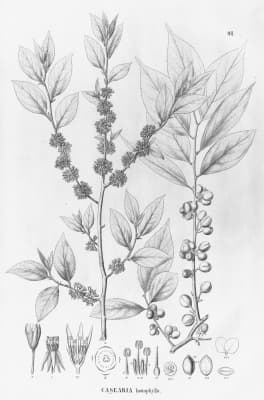
Casearia lasiophylla
Casearia lasiophylla
Safety & Hazards
The fruit is a capsute containing several seeds. Although the capsule of some species (and possibly also the seeds contained therein) is somewhat toxic, the fleshy aril surrounding the seeds is a different matter and in some species (see information below on edibility to see if this is one of them) is often eaten and is considered to be perfectly wholesome[1, PFAF].
Cultivation Details
Plants can succeed in conditions ranging from fairly dense shade to full sun[2]. Young plants have a moderate rate of growth[2].
Propagation
Seed - best sown as soon as it is ripe in a partially shaded position in a nursery seedbed. A low germination rate can usually be expected, with the seed sprouting within 14 - 28 days[2]. When the seedlings are 5 - 6cm tall, pot them up into individual containers and they should be ready to plant out 5 - 7 months later[2]. Cite as: Tropical Plants Database, Ken Fern. tropical.theferns.info. 2026-02-20. <tropical.theferns.info/viewtropical.php?id=Casearia+lasiophylla>
Pollinators
Bees, Insects
References
- [1]Food Plants in the Americas: A Survey of the Domesticated, Cultivated, and Wild Plants Used for Human Food in North, — Kermath B.M.; Bennett B.C.' Pulsipher L.M. · 2014 ↩︎A pre-publication draft of an amazing, on-going work first started in 1985. It contains information on more than 3,900 taxa from the Americas - from Arctic regions to the Tropics
- [2]Brazilian Trees. Volume 2. 4th Edition. — Lorenzi. H. · Instituto Plantarum De Estudos Da Flora; Brazil. · 2002 · ISBN 85-86714-15-1 ↩︎Information on 350 species of Brazilian trees. Stunning photographs of each species, brief details on the plant, its uses and how to grow it from seed. A superb work, with the minor irritation that the translation from Portuguese is not of the best.
- [3]O Gênero Casearia Jacq. No Brasil — Marquete R. & Mansana V.F. · 2016 ↩︎
- [4]Presencia en Argentina de dos Especies de uso múltiple: Acca sellowiana (Myrtaceae) y Casearia lasiophylla (Flacourt — Keller H.A. & Tressens S.G. · 2007 · ISBN 0011-6793 ↩︎
- [5]IUCN Red List of Threatened Species — http://www.iucnredlist.org/ ↩︎A list of plants under threat and facing possible extinction, usually with brief details of the threats and information on habitat.
- [6]Levantamento de plantas medicinais arbóreas e ocorrência em Floresta Ombrófila Mista — Pedroso K. et al · 2007 · ISBN 1808-0251 ↩︎
- [7]Chemical composition and cytotoxic activity of the essential oil from the leaves of Casearia lasiophylla — Salvador M.J. et al · 2011 · http://dx.doi.org/10.1590/S0102-695X2011005000073 · ISBN 0102-695X ↩︎
- [PFAF]Plants for a Future — pfaf.org ↩︎