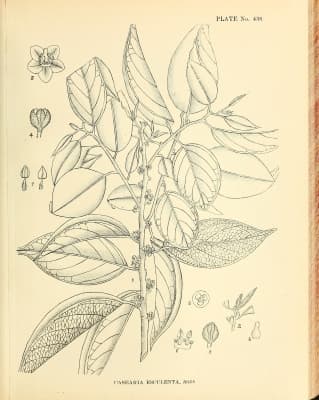
Casearia esculenta
Casearia esculenta
Safety & Hazards
The fruit is a capsute containing several seeds. Although the capsule of some species (and possibly also the seeds contained therein) is somewhat toxic, the fleshy aril surrounding the seeds is a different matter and in some species (such as this one) is often eaten and is considered to be perfectly wholesome[1, PFAF].
Cultivation Details
Not known
Propagation
The seed of species in this genus often has a short period of viability and so is best sown as soon as it is ripe. The seed is collected when the fruits start to open - leave them in the sun to open completely to release the seed, then rinse the seed in water to remove the arils[2]. Sow the seed in a partially shaded position in a nursery seedbed, only just covering the seed, and keep moist. Germination rates vary, but can usually be expected to be low, with the seed sprouting within 20 - 30 days[3]. When the seedlings are 3 - 5cm tall, pot them up into individual containers and they should be ready to plant out a few months later[3]. Cuttings. Cite as: Tropical Plants Database, Ken Fern. tropical.theferns.info. 2026-02-20. <tropical.theferns.info/viewtropical.php?id=Casearia+esculenta>
Pollinators
Data unavailable
References
- [1]Food Plants in the Americas: A Survey of the Domesticated, Cultivated, and Wild Plants Used for Human Food in North, — Kermath B.M.; Bennett B.C.' Pulsipher L.M. · 2014 ↩︎A pre-publication draft of an amazing, on-going work first started in 1985. It contains information on more than 3,900 taxa from the Americas - from Arctic regions to the Tropics
- [2]Iracambi Medicinal Plants — Gallia. E. · 2003 · http://www.iracambi.com/english/herbarium.shtml ↩︎Basic iInformation on 14 plants of the Atlantic Rainforest in Brazil.
- [3]Brazilian Trees. Volume 1. 4th Edition. — Lorenzi. H. · Instituto Plantarum De Estudos Da Flora; Brazil. · 2002 · ISBN 85-86714-17-8 ↩︎Information on 350 species of Brazilian trees. Stunning photographs of each species, brief details on the plant, its uses and how to grow it from seed. A superb work, with the minor irritation that the translation from Portuguese is not of the best.
- [4]A Manual of Indian Timbers. — Gamble. J. S. · Bishen Singh Mahendra Pal Singh · 1972 · ISBN - ↩︎First written in the 19th century, but still a classic, giving a lot of information on the uses and habitats of Indian trees. Not for the casual reader.
- [5]Anti diabetic activity of stem of Casearia esculenta Roxb — Kumar P. · 2008 ↩︎
- [6]A Handbook to the Flora of Ceylon — Trimen H.; continued by Hooker J.D. · Dulau and Co; London. · 1898 · http://www.biodiversitylibrary.org ↩︎Very dated, but still a useful work. It can be downloaded from the Internet.
- [7]Sturtevant's Edible Plants of the World. — Hedrick. U. P. · Dover Publications · 1972 · ISBN 0-486-20459-6 ↩︎Lots of entries, quite a lot of information in most entries and references.
- [8]Pharmacographia Indica — Dymock W.; Warden C.J.H.; Hooper D. · Education Society's Press, Byculla; Mombai. · 1890 · http://www.biodiversitylibrary.org ↩︎Information on the principal plant medicines encountered in India in the 19th century.
- [9]Glossary of Indian Medicinal Plants (Including the Supplement). — Chopra. R. N., Nayar. S. L. and Chopra. I. C. · Council of Scientific and Industrial Research, New Delhi. · 1986 · ISBN - ↩︎Very terse details of medicinal uses of plants with a wide range of references and details of research into the plants chemistry. Not for the casual reader.
- [PFAF]Plants for a Future — pfaf.org ↩︎