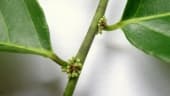
Casearia decandra
Casearia decandra
Safety & Hazards
The fruit is a capsute containing several seeds. Although the capsule of some species (and possibly also the seeds contained therein) is somewhat toxic, the fleshy aril surrounding the seeds is a different matter and in some species (see information below on edibility to see if this is one of them) is often eaten and is considered to be perfectly wholesome[1, PFAF].
Cultivation Details
Casearia decandra is found in areas where the mean annual precipitation ranges from about 900 - 2,200mm[2]. Grows best in a sunny position[3]. Prefers growing in well-drained soils, ranging from coastal sands to upland clays, and on soils derived from sedimentary (including limestone), igneous, and metamorphic rocks[2]. Plants can tolerate periodic inundation of the soil[3]. The plant has a strong taproot, with somewhat finer lateral roots and abundant near-surface fine roots[2]. The plant responds well to coppicing[2]. The plant usually starts flowering and producing fruit whilst still small, usually at around 10cm tall[2]. The plant flowers and fruits irregularly, some plants can usually be found in flower all year round[2]. The flowers are strongly aromatic[4]. When not in flower, this species can easily be confused with Casearia sylvestris[4].
Propagation
Seed - best sown as soon as ripe[3]. Sow in a sunny position in a nursery bed[3]. Seed normally germinates in 3 - 4 weeks, less than 50% normally germinating[3]. Around 90% of seed sown as soon as it was ripe had germinated within 7 days in one trial[2]. Cite as: Tropical Plants Database, Ken Fern. tropical.theferns.info. 2026-02-20. <tropical.theferns.info/viewtropical.php?id=Casearia+decandra>
Pollinators
Bees, Insects
References
- [1]Food Plants in the Americas: A Survey of the Domesticated, Cultivated, and Wild Plants Used for Human Food in North, — Kermath B.M.; Bennett B.C.' Pulsipher L.M. · 2014 ↩︎A pre-publication draft of an amazing, on-going work first started in 1985. It contains information on more than 3,900 taxa from the Americas - from Arctic regions to the Tropics
- [2]Wildland Shrubs of the United States and its Territories: Thamnic Descriptions — Francis J.K. (Editor) · USDA; Forest Service International Institute of Tropical Forestr · 2000 · http://www.fs.fed.us/global/iitf/wildland_shrubs.htm ↩︎An excellent series of papers, in PDF format, from various authors giving quite detailed information on a range of shrubs growing in the United States and its Territories. It can be downloaded from the Internet.
- [3]Brazilian Trees. Volume 2. 4th Edition. — Lorenzi. H. · Instituto Plantarum De Estudos Da Flora; Brazil. · 2002 · ISBN 85-86714-15-1 ↩︎Information on 350 species of Brazilian trees. Stunning photographs of each species, brief details on the plant, its uses and how to grow it from seed. A superb work, with the minor irritation that the translation from Portuguese is not of the best.
- [4]O Gênero Casearia Jacq. No Brasil — Marquete R. & Mansana V.F. · 2016 ↩︎
- [5]Brazilian Fruits and Cultivated Exotics — Lorenzi. H.; Bacher. L.; Lacerda. M.; Sartori. S. · Instituto Plantarum De Estudos Da Flora LTDA; Brazil. · 2000 · ISBN 85-867174-24-0 ↩︎A superb book, giving information on several hundred fruit species. Each entry has a brief description of the plant and its uses, accompanied by one to many excellent quality photographs of the fruits.
- [6]Mansfeld's Database of Agricultural and Horticultural Plants — http://mansfeld.ipk-gatersleben.de/pls/htmldb_pgrc/f?p=185:3:4292127278597336 ↩︎Terse details of a huge range of useful plants.
- [7]Common Trees of Puerto Rico and the Virgin Islands — Little E.L.; Wadsworth F.H. · USDA, Forest Service; Washington. · 1964 ↩︎Contains detailed information, and usually an illustration, on 250 tree species, including both native and exotic species.
- [8]Fruits of the Guianan Flora — van Roosmalen. M.G.M. · Institute of Systematic Boyany, Utrecht University; Netherlands. · 1985 · ISBN 90-9000988-4 ↩︎Terse descriptions of over 1,700 species from the Guianas that bear fruits - not necessarily edible! Often mentions if the fruit is edible, plus gives brief description of habit and habitat.
- [9]Levantamento de plantas medicinais arbóreas e ocorrência em Floresta Ombrófila Mista — Pedroso K. et al · 2007 · ISBN 1808-0251 ↩︎
- [10]Indicador de Madeiras e Plantas Uteis do Brasil. — Fonseca E. T. De · Officinas graphicas Villas-Boas & Co.; Rio de Janeiro · 1922 · http://www.biodiversitylibrary.org ↩︎Brief details of some of the uses of Brazilian plants. It can be downloaded from the Internet.
- [PFAF]Plants for a Future — pfaf.org ↩︎