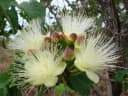
Caryocar brasiliense
Caryocar brasiliense
Safety & Hazards
The seed has a large number of small spines which can injure the mucous membranes of the mouth[1].
Cultivation Details
A plant of the drier tropics and subtropics, it grows naturally in areas with an annual rainfall of 1,000 - 1,500 mm and a dry season of 3 - 5 months, with a relative humidity as low as 13%[2]. Requires a sunny position[1]. Adapted to nutrient poor, heavy clays, especially iron and aluminium rich soils[2]. Established plants are drought tolerant[2, 1]. Large trees may yield up 2,000 fruits[2]. A fairly slow-growing tree, reaching a height of up to 1.5 metres when two years old[1]. The tree has potential as an oil crop for the drier regions of the world, being well-adapted to nutrient poor soils and long dry seasons[2].
Propagation
Seeds - they contain a germination inhibitor and can take one year to germinate;[2, 1]. Stratification of the endocarp with mesocarp removed is recommended[2]. Alternatively, immerse the seeds in warm water for 48 hours, changing the water every 12 hours[1]. Sow the seed in individual containers in a sunny or lightly shaded position. Pre-soaked seed can sprout within 30 - 50 days with a moderate germination rate[1]. Seedlings can be planted out when 25 cm tall[2]. Good results can be obtained from grafting and marcottage[2]. Cite as: Tropical Plants Database, Ken Fern. tropical.theferns.info. 2026-02-20. <tropical.theferns.info/viewtropical.php?id=Caryocar+brasiliense>
Pollinators
Data unavailable
References
- [1]Brazilian Trees. Volume 1. 4th Edition. — Lorenzi. H. · Instituto Plantarum De Estudos Da Flora; Brazil. · 2002 · ISBN 85-86714-17-8 ↩︎Information on 350 species of Brazilian trees. Stunning photographs of each species, brief details on the plant, its uses and how to grow it from seed. A superb work, with the minor irritation that the translation from Portuguese is not of the best.
- [2]Edible Nuts. — Wickens G.E. · FAO, Rome. · 1995 · http://www.fao.org/docrep/ · ISBN 92-5-103748-5 ↩︎Detailed information on 20 of the most valuable nut crops, plus more basic information on a wide range of other nut-producing plants. It can be downloaded from the Internet.
- [3]Brazilian Fruits and Cultivated Exotics — Lorenzi. H.; Bacher. L.; Lacerda. M.; Sartori. S. · Instituto Plantarum De Estudos Da Flora LTDA; Brazil. · 2000 · ISBN 85-867174-24-0 ↩︎A superb book, giving information on several hundred fruit species. Each entry has a brief description of the plant and its uses, accompanied by one to many excellent quality photographs of the fruits.
- [4]Medicinal Plants of Brazil — Mors W.B.; Rizzini C.T.; Pereira N.A. · Reference Publications; Michigan. · 2000 · ISBN 0-917256-42-5 ↩︎An extremely concise book, listing approximately 1,500 species and varieties of plants with their botanical name, common name in Brazil, regions in Brazil where the plant is found, a brief list of uses and any medically active compounds in the plant.
- [5]Levantamento etnobotânico de plantas popularmente utilizadas como antiúlceras e antiinflamatórias pela comunidade de — De Jesus, N.Z.T. et al · 2009 · ISBN 0102-695X ↩︎