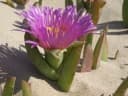
Carpobrotus chilensis
Carpobrotus chilensis
Safety & Hazards
None known
Cultivation Details
A plant of lowland, mainly warm temperate and subtropical maritime areas, though it has become naturalized in parts of the tropics, including the coast of Ecuador. Requires a sunny position, though in very hot climates it can benefit from some afternoon shade[1]. Requires a well-drained soil, growing well in poor sandy soils. Plants are tolerant of salt-laden winds. There are various reports of the plant becoming naturalized outside its native range[PFAF]. Plants can flower and fruit all year round[2]. The flowers open in the morning and close at night[2].
Propagation
Seed - surface sow in containers. Lower night-time temperatures are beneficial. The seed usually germinates in 7 - 10 days at 23°c[3]. When they are large enough to handle, prick the seedlings out into individual pots and grow them on until large enough to plant out. Cuttings at any time during the growing season. Allow the cutting to dry in the sun for a day or two then pot up in a very sandy mix. Very easy[PFAF]. Cite as: Tropical Plants Database, Ken Fern. tropical.theferns.info. 2026-02-20. <tropical.theferns.info/viewtropical.php?id=Carpobrotus+chilensis>
Pollinators
Data unavailable
References
- [1]Desert Tropicals — http://www.desert-tropicals.com/ ↩︎The main focus of the site is succulent plants, but it also contains information on a wide range of other species. Usually at least one good photograph, plus basic information about the plant and its cultivation.
- [2]Flora of N. America — http://flora.huh.harvard.edu/fna/ ↩︎An on-line version of the flora with an excellent description of the plant including a brief mention of plant uses.
- [3]Growing from Seed. Volume 3. — Bird. R. (Editor) · Thompson and Morgan. · 1989 · ISBN - ↩︎Very readable magazine with lots of information on propagation.
- [4]Dictionary of Economic Plants. — Uphof. J. C. Th. · Weinheim · 1959 · ISBN - ↩︎An excellent and very comprehensive guide but it only gives very short descriptions of the uses without any details of how to utilize the plants. Not for the casual reader.
- [5]Inventory of Seeds and Plants Imported. Vol. 51 — USDA Government Printing Office; Washington DC. · 1922 · http://www.biodiversitylibrary.org ↩︎Details of seeds and plants imported for trials by the United States Department of Agriculture in the second quarter of 1917, often detailing the uses of the plant and various other miscellaneous information. It can be downloaded from the Internet.
- [6]RHS Dictionary of Plants plus Supplement. 1956 — F. Chittendon. · Oxford University Press · 1951 · ISBN - ↩︎Comprehensive listing of species and how to grow them. Somewhat outdated, it has been replaced in 1992 by a new dictionary (see [ 200 ]).
- [7]Sturtevant's Edible Plants of the World. — Hedrick. U. P. · Dover Publications · 1972 · ISBN 0-486-20459-6 ↩︎Lots of entries, quite a lot of information in most entries and references.
- [8]Growing Unusual Fruit. — Simmons. A. E. · David & Charles; Newton Abbot. · 1972 · ISBN 0-7153-5531-7 ↩︎A very readable book with information on about 100 species that can be grown in Britain (some in greenhouses) and details on how to grow and use them.
- [9]Food for Free. — Mabey. R. · Collins · 1974 · ISBN 0-00-219060-5 ↩︎Edible wild plants found in Britain. Fairly comprehensive, very few pictures and rather optimistic on the desirability of some of the plants.
- [10]Encyclopaedia of Medicinal Plants. — Chiej. R. · MacDonald · 1984 · ISBN 0-356-10541-5 ↩︎Covers plants growing in Europe. Also gives other interesting information on the plants. Good photographs.
- [11]Cornucopia - A Source Book of Edible Plants. — Facciola. S. · Kampong Publications · 1990 · ISBN 0-9628087-0-9 ↩︎Excellent. Contains a very wide range of conventional and unconventional food plants (including tropical) and where they can be obtained (mainly N. American nurseries but also research institutes and a lot of other nurseries from around the world.
- [12]Native Edible Plants of New Zealand. — Crowe. A. · Hodder and Stoughton · 1990 · ISBN 0-340-508302 ↩︎A very well written and illustrated book based on the authors own experiments with living on a native diet.
- [13]PlantZAfrica.com — http://www.plantzafrica.com ↩︎An excellent site giving detailed descriptions and uses of many S. African plants.
- [PFAF]Plants for a Future — pfaf.org ↩︎