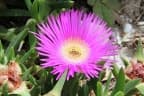
Carpobrotus acinaciformis
Carpobrotus acinaciformis
Safety & Hazards
None known
Cultivation Details
Carpobrotus acinaciformis succeeds in the drier parts of the tropics and subtropics, and also in the warmer parts of the temperate zone. They are not very cold tolerant resistant and can be killed by prolonged temperatures below about -2°c. They have naturalized themselves on cliffs along the coast of S. Britain but do not succeed inland unless grown in a sunny sheltered position[1]. Requires a well-drained sandy soil in a sunny position[2, 1]. Plants can be grown on dry walls or in the flower border[3]. Established plants are very drought resistant[1]. Very resistant to wind and salt spray[3]. Moderately fire-retardant[1]. The fruits are sometimes sold in local markets in S. Africa, being popular for making jams and curry dishes[4]. A vigorous prostrate plant, rooting as it spreads. The flowers only open in the afternoon[1].
Propagation
Seed - surface sow early spring to early summer in a greenhouse. Lower night-time temperatures are beneficial. The seed usually germinates in 7 - 10 days at 23°c[5]. When they are large enough to handle, prick the seedlings out into individual pots and grow them on in a greenhouse for at least their first winter. Plant them out into their permanent positions in late spring or early summer, after the last expected frosts. Cuttings at any time during the growing season. Allow the cutting to dry in the sun for a day or two then pot up in a very sandy mix. Very easy[PFAF]. Cite as: Temperate Plants Database, Ken Fern. temperate.theferns.info. 2026-02-20. <temperate.theferns.info/plant/Carpobrotus+acinaciformis>
Pollinators
Bees
References
- [1]The New RHS Dictionary of Gardening. 1992. — Huxley. A. · MacMillan Press · 1992 · ISBN 0-333-47494-5 ↩︎Excellent and very comprehensive, though it contains a number of silly mistakes. Readable yet also very detailed.
- [2]RHS Dictionary of Plants plus Supplement. 1956 — F. Chittendon. · Oxford University Press · 1951 · ISBN - ↩︎Comprehensive listing of species and how to grow them. Somewhat outdated, it has been replaced in 1992 by a new dictionary (see [ 200 ]).
- [3]The Milder Garden. — Taylor. J. · Dent · 1990 ↩︎A good book on plants that you didn't know could be grown outdoors in Britain.
- [4]Medicinal Plants of South Africa — van Wyk B.; van Oudtshoorn B.; Gericke N. · Briza Publications; Pretoria, S. Africa. · 1997 · ISBN 1-875093-09-5 ↩︎An excellent guide, containing information on over 130 medicinal herbs of S. Africa. It gives a reasonable description of each plant, with excellent photos and details of medicinal uses and active ingredients.
- [5]Growing from Seed. Volume 3. — Bird. R. (Editor) · Thompson and Morgan. · 1989 · ISBN - ↩︎Very readable magazine with lots of information on propagation.
- [6]Conservatory and Indoor Plants Volumes 1 & 2 — Phillips. R. & Rix. M. · Pan Books, London. · 1998 · ISBN 0-330-37376-5 ↩︎Excellent photos of over 1,100 species and cultivars with habits and cultivation details plus a few plant uses. Many species are too tender for outdoors in Britain though there are many that can be grown outside.
- [7]A Dictionary of Plants Used by Man. — Usher. G. · Constable · 1974 · ISBN 0094579202 ↩︎Forget the sexist title, this is one of the best books on the subject. Lists a very extensive range of useful plants from around the world with very brief details of the uses. Not for the casual reader.
- [8]Flowers of the Mediterranean. — Polunin. O. and Huxley. A. · Hogarth Press · 1987 · ISBN 0-7012-0784-1 ↩︎A very readable pocket flora that is well illustrated. Gives some information on plant uses.
- [9]Dictionary of Economic Plants. — Uphof. J. C. Th. · Weinheim · 1959 · ISBN - ↩︎An excellent and very comprehensive guide but it only gives very short descriptions of the uses without any details of how to utilize the plants. Not for the casual reader.
- [10]Tanaka's Cyclopedia of Edible Plants of the World. — Tanaka. T. & Nakao S. · Keigaku Publishing; Tokyo · 1976 · ISBN - ↩︎The most comprehensive list of edible plants I've come across. Only the briefest entry for each species, though, and some of the entries are more than a little dubious. Not for the casual reader.
- [11]Plants for Human Consumption. — Kunkel. G. · Koeltz Scientific Books · 1984 · ISBN 3874292169 ↩︎An excellent book for the dedicated. A comprehensive listing of Latin names with a brief list of edible parts.
- [12]Sturtevant's Edible Plants of the World. — Hedrick. U. P. · Dover Publications · 1972 · ISBN 0-486-20459-6 ↩︎Lots of entries, quite a lot of information in most entries and references.
- [13]Native Edible Plants of New Zealand. — Crowe. A. · Hodder and Stoughton · 1990 · ISBN 0-340-508302 ↩︎A very well written and illustrated book based on the authors own experiments with living on a native diet.
- [14]Plants for Ground Cover — Thomas. G. S. · J. M. Dent & Sons · 1990 · ISBN 0-460-12609-1 ↩︎An excellent detailled book on the subject, very comprehensive.
- [PFAF]Plants for a Future — pfaf.org ↩︎