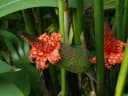
Carludovica palmata
Carludovica palmata
Safety & Hazards
The fruits contain calcium oxalate crystals[1].
Cultivation Details
A plant of the moist tropics, where it is found at elevations up to 800 metres. It grows best in areas where annual daytime temperatures are within the range 24 - 32°c, but can tolerate 12 - 37°c[2]. It prefers a mean annual rainfall in the range 1,200 - 1,800mm, but tolerates 800 - 2,200mm[2]. Succeeds in full sun, but prefers a shady position, growing well in the shade of trees[3]. Prefers a fertile, moist but well-drained soil. Prefers a pH in the range 5 - 6, tolerating 4.5 - 6.5[2]. When grown from seed, the first leaves are ready for harvesting after about 7 years[2]. If suckers are used, the leaves can be harvested after about 18 months, by which stage there will be about 20 - 30 leaves[2].
Propagation
Seed - Cite as: Tropical Plants Database, Ken Fern. tropical.theferns.info. 2026-02-20. <tropical.theferns.info/viewtropical.php?id=Carludovica+palmata>
Pollinators
Data unavailable
References
- [1]Brazilian Fruits and Cultivated Exotics — Lorenzi. H.; Bacher. L.; Lacerda. M.; Sartori. S. · Instituto Plantarum De Estudos Da Flora LTDA; Brazil. · 2000 · ISBN 85-867174-24-0 ↩︎A superb book, giving information on several hundred fruit species. Each entry has a brief description of the plant and its uses, accompanied by one to many excellent quality photographs of the fruits.
- [2]Ecocrop — http://ecocrop.fao.org/ecocrop/srv/en/home ↩︎Basic information on a wide range of useful plants, plus details of environmental needs where available.
- [3]Tropical Ornamentals; A Guide — Whistler. W. Arthur. · Timber Press Inc. Oregon. · 2000 · ISBN 0-88192-448-2 ↩︎An excellent little guide to some of the more commonly cultivated ornamental plants of the Tropics, often giving some information on the plants other uses.
- [4]Flora of Guatemala — Standley P.C. & J. A. Steyermark · 1946 - 1976 · http://www.archive.org/ ↩︎A superb reference, though somewhat dated. Gives lots of plant uses as well as information on plant habit and habitat. The entire flora (13 volumes) can now be downloaded from http://www.archive.org/
- [5]Dictionary of Economic Plants. — Uphof. J. C. Th. · Weinheim · 1959 · ISBN - ↩︎An excellent and very comprehensive guide but it only gives very short descriptions of the uses without any details of how to utilize the plants. Not for the casual reader.
- [6]The New RHS Dictionary of Gardening. 1992. — Huxley. A. · MacMillan Press · 1992 · ISBN 0-333-47494-5 ↩︎Excellent and very comprehensive, though it contains a number of silly mistakes. Readable yet also very detailed.
- [7]Plant Resources of Southeast Asia — http://proseanet.org/ ↩︎Lots of information on the uses of the plants of SE Asia.
- [8]Useful Plants of the Siona and Secoya Indians of Eastern Ecuador. — Vickers W.T.; Plowman T. · Field Museum of Natural History; USA. · 1984 · http://www.biodiversitylibrary.org · ISBN 0015 - 0746 ↩︎Very terse, but it gives the uses of a large number of species. It can be downloaded from the Internet.
- [9]Cornucopia II — Facciola. S. · Kampong Publications, California. · 1998 · ISBN 0-9628087-2-5 ↩︎The second edition of an excellent guide to the edible uses of plants, though it does not give any details of cultivation etc.
- [10]Useful Fiber Plants of the World — Dodge C.R. · USDA; Washington. · 1897 · http://www.biodiversitylibrary.org/ ↩︎A rather dated, but very comprehensive catalogue of fibre plants from around the world. The book can be downloaded from the Internet.
- [11]Medicinal Plants in the South Pacific — WHO Regional Publications, Manilla. · 1998 · ISBN 92-9061-118-9 ↩︎Excellent guide to 102 medicinal herbs of the Pacific Islands, with photographs of each plant and details of their constituents, biological activities and traditional uses. A description of each plant, together with habitat and distribution is given.
- [PFAF]Plants for a Future — pfaf.org ↩︎