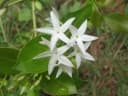
Apocynaceae FAMILY
Carissa carandas
Carissa carandas
Edibility
3/5
Medicinal
2/5
Safety & Hazards
None known
Cultivation Details
HabitShrub
Growth—
A plant of subtropical to tropical areas, where it is found at elevations up to metres. It grows best in areas where annual daytime temperatures are within the range 23 - 30°c, but can tolerate 16 - 34°c[1]. It can be killed by temperatures of -2°c or lower[1]. It prefers a mean annual rainfall in the range 1,000 - 1,400mm, but tolerates 700 - 2,700mm[1]. Succeeds in full sun and in dappled shade[1]. Prefers a medium-acid soil[2]. Prefers a pH in the range 6.5 - 8, tolerating 6 - 8.5[1]. Plants take about 3 years to come into bearing from seed, 1 - 3 years from cuttings[2]. Plants can flower all year round[2].
References
- [1]Ecocrop — http://ecocrop.fao.org/ecocrop/srv/en/home ↩︎Basic information on a wide range of useful plants, plus details of environmental needs where available.
- [2]Perennial Edible Fruits of the Tropics : an Inventory — Martin, F. W.; Campbell, C. W.; Rubertbe, R. M. · U.S. Dept. of Agriculture, Agricultural Research Service · 1987 ↩︎A booklet giving terse details of almost 300 species of edible fruits, plus regional lists of Botanical and Common names for over 2,500 less well-known edible fruits of the tropics.
- [3]Plant Resources of Southeast Asia — http://proseanet.org/ ↩︎Lots of information on the uses of the plants of SE Asia.
- [4]Trade Winds Fruit — http://www.tradewindsfruit.com/index.htm ↩︎The on-line catalogue of a company selling seeds. Gives descriptions, photos and uses of a very wide range of fruit and other food-producing plants plus ornamentals.
- [5]Under-Utilized Tropical Fruits of Thailand. RAP — Suranant Subhadrabandhu · F. A. O., The United Nations, Bangkok. · 2001 · http://www.fao.org/3/a-ab777e.pdf ↩︎A detailed report on 35 fruit species that could have potential for increased production in Thailand. The report can be downloadd as a PDF from the internet.
- [6]Plants and People of Nepal — Manandhar. N. P. · Timber Press. Oregon. · 2002 · ISBN 0-88192-527-6 ↩︎Excellent book, covering over 1,500 species of useful plants from Nepal together with information on the geography and peoples of Nepal. Good descriptions of the plants with terse notes on their uses.
- [7]Cornucopia II — Facciola. S. · Kampong Publications, California. · 1998 · ISBN 0-9628087-2-5 ↩︎The second edition of an excellent guide to the edible uses of plants, though it does not give any details of cultivation etc.