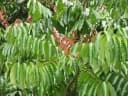
Carapa guianensis
Carapa guianensis
Safety & Hazards
None known
Cultivation Details
A plant of the moister, lowland tropics, usually found at elevations below 700 metres but occasionally found as high as 1,000 metres[1]. It grows in areas where the annual rainfall is above 3,000 mm and the temperature ranges between 20 - 35°c[1]. Plants generally grow in moister soils and are tolerant of periodic flooding[1]. They are moderately tolerant of shade, but full overhead light is required for fast growth[1]. Young plants produce taproots but the trees tend to become surface rooted as they grow older[1]. In South America, the tree showed a mean annual diameter increment of 1.6 - 2 metres in 25-year-old plantations. In swamp forests, trees can reach felling size in 20 - 25 years; at higher elevations probably in 40 - 60 years[1, 2]. Flowering period depends heavily on the climate but is usually concentrated in one short period each year[1]. Pollination is probably by insects; the trees are often found swarming with ants visiting extrafloral nectaries at shoot apices and leaflet tips[1]. Usually only 1 - 2 fruits in an inflorescence mature in 8 - 12 months[1]. A large tree may produce 750 - 4,000 seeds per year, but seed production may be almost zero in unfavourable years[1]. The seeds float and are thus dispersed by water, but are also scatter-hoarded by agoutis and occasionally by pigs[1]. Trees coppice freely and are resistant to fire[1]
Propagation
Seed - fresh seed germinates best, germination rates dropping if the seed dries out[1]. The seed should be sown on the surface or shallowly covered in moist soil. Germination takes 19 - 21 days for fresh seed, this can be reduced to 6 - 7 days if the seed is scarified first[1]. Germination rate of fresh seeds is often 100%[1]. Early growth in the nursery is moderately fast, and seedlings may attain 0.5 m in the 1st year. The roots of 1-year-old seedlings are pruned at about 15 cm whilst the plant is still in the nursery bed; when new rootlets begin to develop, the plant is uprooted and planted out[1] Seed can only be stored for a short time, germination rates of 100% have been observed in 2 month old seed, but there was no germination after 3 months of open storage at 24 - 31C[1]. No seeds survived following 7 months of storage in paper bags at 12 C, whereas viability is halved with fresh seeds sealed in polythene bags at this temperatures after 7 months[1]. Large cuttings can be used when planted in swampy soil[1]. Cite as: Tropical Plants Database, Ken Fern. tropical.theferns.info. 2026-02-20. <tropical.theferns.info/viewtropical.php?id=Carapa+guianensis>
Pollinators
Data unavailable
References
- [1]World Agroforesty Centre — http://www.worldagroforestry.org/ ↩︎An excellent online database of a huge range of trees giving very good information on each plant - its uses, ecology, identity, propagation, pests etc.
- [2]Present and Potential Commercial Timbers of the Caribbean — Longwood.F.R. · USDA Forest Service; Washington, DC. · 1962 ↩︎Quite detailed information on more than 60 species of Caribbean timber trees, giving species descriptions, habitat, detailed info on the wood and some info on other uses. Available for download on the internet.
- [3]Medicinal Plants of the Guianas — DeFilipps, R. A.; Maina, S. L.; & Crepin, J. · Smithsonian Museum · http://botany.si.edu/bdg/medicinal/index.html ↩︎A down-loadable PDF document of a book in pre-publication awaiting illustration. An excellent, if rather terse, guide to the traditional medicinal uses of the plants of the region
- [4]Dictionary of Economic Plants. — Uphof. J. C. Th. · Weinheim · 1959 · ISBN - ↩︎An excellent and very comprehensive guide but it only gives very short descriptions of the uses without any details of how to utilize the plants. Not for the casual reader.
- [5]Brazilian Trees. Volume 1. 4th Edition. — Lorenzi. H. · Instituto Plantarum De Estudos Da Flora; Brazil. · 2002 · ISBN 85-86714-17-8 ↩︎Information on 350 species of Brazilian trees. Stunning photographs of each species, brief details on the plant, its uses and how to grow it from seed. A superb work, with the minor irritation that the translation from Portuguese is not of the best.
- [6]Tropix 7 — CIRAD · http://tropix.cirad.fr/en ↩︎An on-line guide to the timbers of 245 species of trees.