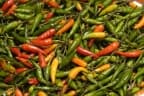
Capsicum frutescens
Capsicum frutescens
Safety & Hazards
Although providing many well-known foods for people, including the potato, tomato, pepper and aubergine, most plants in the family Solanaceae also contain poisonous alkaloids. Apart from the specific entries mentioned below containing information on the edible uses for this species, it would be unwise to ingest any other part of this plant[PFAF]. The sap of the plant can cause the skin to blister[1].
Cultivation Details
Capsicum frutescens grows well in lowland tropical regions and at an elevation up to 2,000 metres[2]. It is also cultivated as an annual in the subtropics and warm temperate areas. It prefers a temperature in the range 21 - 25°c, not growing well if temperatures exceed 32°c[2]. Plants are not tolerant of frost[3]. Annual precipitation of 600 - 1,200mm is considered to be adequate[2]. Excessive rainfall can reduce flowering and fruit set, as well as encourage diseases[2]. Prefers a very warm sunny position and a humus-rich, fertile, well-drained loam[2]. Prefers a light sandy soil that is slightly acid[4]. Prefers a pH in the range of 5.5 - 5.6[2], but tolerates 4.3 to 8.3. Often grown as an annual crop, the first harvest can be obtained about 3 months after sowing the seed[2]. Yields of 350 - 500kg of the dried fruit can be obtained per hectare[2]. Often cultivated for its fruit, there are many named varieties[5, 6]. The growing plant is a good companion for aubergines[7].
Propagation
Seed - sow late winter to early spring in a warm greenhouse[8]. The seed usually germinates in 3 - 4 weeks at 20°c. Prick out the seedlings into individual pots of reasonably rich soil and grow them on fast. If trying them outdoors, then plant them out after the last expected frosts and give them the protection of a cloche or frame at least until they are established and growing away well. Cite as: Temperate Plants Database, Ken Fern. temperate.theferns.info. 2026-02-20. <temperate.theferns.info/plant/Capsicum+frutescens>
Pollinators
Insects, Self
References
- [1]The New RHS Dictionary of Gardening. 1992. — Huxley. A. · MacMillan Press · 1992 · ISBN 0-333-47494-5 ↩︎Excellent and very comprehensive, though it contains a number of silly mistakes. Readable yet also very detailed.
- [2]Vegetables in the Tropics — Tindall. H. D. · MacMillan, Oxford. · 1983 · ISBN 0-333-24268-8 ↩︎An excellent, in-depth look at the main vegetable crops that can be grown in the Tropics, plus many less well-known plants.
- [3]The Oxford Book of Food Plants. — Harrison. S. Wallis. M. Masefield. G. · Oxford University Press · 1975 · ISBN - ↩︎Good drawings of some of the more common food plants from around the world. Not much information though.
- [4]A - Z of Companion Planting. — Allardice.P. · Cassell Publishers Ltd. · 1993 · ISBN 0-304-34324-2 ↩︎A well produced and very readable book.
- [5]Fruits of the Earth. — Bianchini. F., Corbetta. F. and Pistoia. M. ↩︎Lovely pictures, a very readable book.
- [6]Cornucopia - A Source Book of Edible Plants. — Facciola. S. · Kampong Publications · 1990 · ISBN 0-9628087-0-9 ↩︎Excellent. Contains a very wide range of conventional and unconventional food plants (including tropical) and where they can be obtained (mainly N. American nurseries but also research institutes and a lot of other nurseries from around the world.
- [7]Companion Planting for Successful Gardening. — Riotte. L. · Garden Way, Vermont, USA. · 1978 · ISBN 0-88266-064-0 ↩︎Fairly good.
- [8]Growing from Seed. Volume 3. — Bird. R. (Editor) · Thompson and Morgan. · 1989 · ISBN - ↩︎Very readable magazine with lots of information on propagation.
- [9]Medicinal Plants in Papua New Guinea — World Health Organisation · 2009 · ISBN 978-92-9061-249-0 ↩︎Traditional medicinal uses of 126 species from Papua New Guinea, including information on modern research into the plants.
- [10]Dictionary of Economic Plants. — Uphof. J. C. Th. · Weinheim · 1959 · ISBN - ↩︎An excellent and very comprehensive guide but it only gives very short descriptions of the uses without any details of how to utilize the plants. Not for the casual reader.
- [11]Plants Consumed by Man. — Brouk. B. · Academic Press · 1975 · ISBN 0-12-136450-x ↩︎Readable but not very comprehensive.
- [12]Sturtevant's Edible Plants of the World. — Hedrick. U. P. · Dover Publications · 1972 · ISBN 0-486-20459-6 ↩︎Lots of entries, quite a lot of information in most entries and references.
- [13]A Modern Herbal. — Grieve. · Penguin · 1984 · ISBN 0-14-046-440-9 ↩︎Not so modern (1930's?) but lots of information, mainly temperate plants.
- [14]The Encyclopedia of Herbs and Herbalism — Stuart. M. (Editor) · Orbis Publishing. London. · 1979 · ISBN 0-85613-067-2 ↩︎Excellent herbal with good concise information on over 400 herbs.
- [15]The Encyclopedia of Medicinal Plants — Chevallier. A. · Dorling Kindersley. London · 1996 · ISBN 9-780751-303148 ↩︎An excellent guide to over 500 of the more well known medicinal herbs from around the world.
- [16]Encyclopaedia of Medicinal Plants. — Chiej. R. · MacDonald · 1984 · ISBN 0-356-10541-5 ↩︎Covers plants growing in Europe. Also gives other interesting information on the plants. Good photographs.
- [17]The Dictionary of Modern Herbalism. — Mills. S. Y. ↩︎An excellent small herbal.
- [18]Economic Botany. — Hill. A. F. · The Maple Press · 1952 · ISBN - ↩︎Not very comprehensive, but it is quite readable and goes into some detail about the plants it does cover.
- [19]Encyclopaedia of Herbs and their Uses. — Bown. D. · Dorling Kindersley, London. · 1995 · ISBN 0-7513-020-31 ↩︎A very well presented and informative book on herbs from around the globe. Plenty in it for both the casual reader and the serious student. Just one main quibble is the silly way of having two separate entries for each plant.
- [PFAF]Plants for a Future — pfaf.org ↩︎