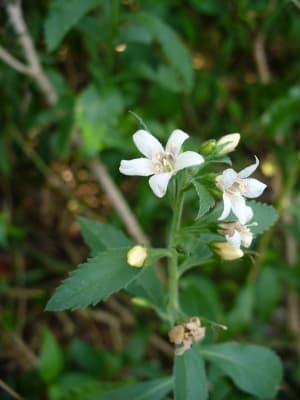
Capraria biflora
Capraria biflora
Cultivation Details
A plant of lowland areas in the tropics and subtropics, where it can be found at elevations up to 1,000 metres[2]. In Puerto Rico, it occurs in areas that receive from 750 - 1,700mm of precipitation a year[2]. Requires a sunny position[2]. The plant grows on soils derived from both sedimentary and igneous rocks in a wide range of soil textures and fertility but requires well-drained conditions[2]. The plant flowers and produces seed all year round[2]. Plants readily sprout from the lower stem or root when they have been cut or burned[2].
Propagation
Seed - best surface sown because it is so small. Press the seed gently into the soil and make sure it does not dry out. In one germination test, 21% of the seed germinated within 10 - 35 days[2]. Cite as: Tropical Plants Database, Ken Fern. tropical.theferns.info. 2026-02-20. <tropical.theferns.info/viewtropical.php?id=Capraria+biflora>
Pollinators
Data unavailable
References
- [1]Flora of Costa Rica — Standley P.C. · Field Museum of Natural History; Chicago · 1938 · http://www.archive.org/ ↩︎Rather dated, but an excellent treatment of the area. Available for download from the internet.
- [2]Wildland Shrubs of the United States and its Territories: Thamnic Descriptions — Francis J.K. (Editor) · USDA; Forest Service International Institute of Tropical Forestr · 2000 · http://www.fs.fed.us/global/iitf/wildland_shrubs.htm ↩︎An excellent series of papers, in PDF format, from various authors giving quite detailed information on a range of shrubs growing in the United States and its Territories. It can be downloaded from the Internet.
- [3]Flora of Guatemala — Standley P.C. & J. A. Steyermark · 1946 - 1976 · http://www.archive.org/ ↩︎A superb reference, though somewhat dated. Gives lots of plant uses as well as information on plant habit and habitat. The entire flora (13 volumes) can now be downloaded from http://www.archive.org/
- [4]Mansfeld's Database of Agricultural and Horticultural Plants — http://mansfeld.ipk-gatersleben.de/pls/htmldb_pgrc/f?p=185:3:4292127278597336 ↩︎Terse details of a huge range of useful plants.
- [5]Cornucopia II — Facciola. S. · Kampong Publications, California. · 1998 · ISBN 0-9628087-2-5 ↩︎The second edition of an excellent guide to the edible uses of plants, though it does not give any details of cultivation etc.
- [6]Medicinal Plants of the Guianas — DeFilipps, R. A.; Maina, S. L.; & Crepin, J. · Smithsonian Museum · http://botany.si.edu/bdg/medicinal/index.html ↩︎A down-loadable PDF document of a book in pre-publication awaiting illustration. An excellent, if rather terse, guide to the traditional medicinal uses of the plants of the region