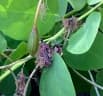
Capparis spinosa cordifolia
Capparis spinosa cordifolia
Safety & Hazards
Caper extracts and pulps have been used in cosmetics, but there have been cases reported of contact dermatitis and sensitivity from their use[1].
Cultivation Details
Grows best in a sunny position[2]. Prefers a well-drained soil[2]. Established plants are drought tolerant[2]. In the wild the plant is tolerant of salt-laden winds[2]. The plant can be a rather fussy grower under cultivation[2]. Once established, the plant grows rapidly and soon produces flowers[2]. Plants can flower all year round[3]. The flowers open in the evening and fade the following morning[3].
Propagation
Caper seeds are miniscule and seedlings are very slow growing. The fresh seed germinates quickly, although germination rates are usually quite low[1]. Dried seed becomes dormant and notably difficult to germinate - pre-soak for 24 hours in warm water at around 40°c which is then allowed to cool. Then wrap them in a moist cloth, place them in a sealed glass jar and kept in the refrigerator for 2 - 3 months. After refrigeration, soak the seeds again in warm water overnight. Sow the seeds about 1cm deep in a loose well drained soil medium[1]. Cuttings of half-ripe wood in a sandy medium[4]. Use stems from the basal portions, greater than 1cm diameter and 8cm long with 6 - 10 buds. Use a loose, well drained media with bottom heat. A 70% rooting percentage would be considered good[1] Cite as: Tropical Plants Database, Ken Fern. tropical.theferns.info. 2026-02-20. <tropical.theferns.info/viewtropical.php?id=Capparis+spinosa+cordifolia>
Pollinators
Data unavailable
References
- [1]New Crops FactSheets — Purdue University · http://www.hort.purdue.edu/newcrop/default.html ↩︎A website dedicated to giving information on potential new agricultural crops.
- [2]Native Plants Hawaii — http://nativeplants.hawaii.edu/plant/ ↩︎A website containing information on a range of native Hawaiian plants, with descriptions, habitat, traditional uses etc.
- [3]A taxonomic revision of the Capparis spinosa group (Capparaceae) from eastern Africa to Oceania — Silvio Fici · 2015 · http://www.mapress.com/phytotaxa/ · ISBN 1179-3155 ↩︎
- [4]The New RHS Dictionary of Gardening. 1992. — Huxley. A. · MacMillan Press · 1992 · ISBN 0-333-47494-5 ↩︎Excellent and very comprehensive, though it contains a number of silly mistakes. Readable yet also very detailed.
- [5]The Useful Plants of the Island of Guam — Safford W.E. · Smithsonian Institute; Washington. · 1905 · http://www.biodiversitylibrary.org/ ↩︎A very comprehensive, if rather dated, guide to the plants of Guam. It can be downloaded from the Internet.