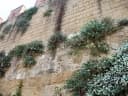
Capparis spinosa
Capparis spinosa
Safety & Hazards
Caper extracts and pulps have been used in cosmetics, but there have been cases reported of contact dermatitis and sensitivity from their use[1].
Cultivation Details
Capparis spinosa is a plant of drier warm temperate areas with hot summers, extending through the subtropics to tropical areas. It is found at elevations up to 3,000 metres. It grows best in areas where annual daytime temperatures are within the range 13 - 27°c, but can tolerate 10 - 31°c[2]. Dormant plants can tolerate short-lived temperatures falling to between -5 and -10°c[3, 4]. The plant prefers a mean annual rainfall in the range 500 - 1,000mm, but tolerates 300 - 2,600mm[2]. Requires a hot, well-drained dry position in full sun[3, 4, 5]. Plants can tolerate some frost so long as the ground is very well-drained. Dislikes heavy soils[2]. Established plants are very tolerant of drought[5]. Prefers a pH in the range 6.5 - 7.5, tolerating 6 - 8.3[2]. Capers are often cultivated in tropical, sub-tropical and warm temperate zones for their aromatic flower buds, which are used as a condiment[3]. Capparis spinosa is a very variable species that has at times been considered to be several distinct species. It is currently (2017) treated as one species with several subspecies. These subspecies are:- Capparis spinosa spinosa. A very spiny, prostrate-spreading to ascending shrub with branches to 3 metres long. Found in the Mediterranean, Arabian Peninsula, Middle East to China, Nepal and India. It is commonly harvested from the wild for food and medicine and very occasionally cultivated[6]. See separate entry for more information. Capparis spinosa rupestris (Sm.) Nyman. An unarmed or sparsely armed shrub with pendulous branches 3 - 4 metres long. It is found in southern Europe, northern Africa and Anatolia. Extensively harvested from the wild for food and sometimes used as a medicine, it is often cultivated for food, especially in Spain and Italy, and is also grown as an ornamental[6]. See separate entry for more information. Capparis spinosa cartilaginea (Decne.) Maire & Weiller. A thorny, usually erect shrub growing 60 - 400cm tall. Found in northeastern and eastern Africa, through Arabia and the Levant to Pakistan and India. Often harvested from the wild as a medicine, it is also sometimes eaten[7]. Capparis spinosa cordifolia (Lam.) Fici. A thorny, erect or prostrate shrub with branches usually 1 - 2 metres long. Native to tropical regions from Indonesia and the Phillipines westwards through the Pacific. It is harvested from the wild for use as a medicine and a food[7]. Capparis spinosa nummularia (DC.) Fici. A thorny, prostrate-spreading shrub with branches up to 2 metres long. Native to northern Australia. The fruit is a traditional Aboriginal food[7]. Capparis spinosa himalayensis (Jafri) Fici. A thorny, prostrate-spreading shrub. Native to the Himalayas of Pakistan, India and Nepal[7]. See separate entry for more information. Young caper plants can sometimes commence flowering in their first year after planting out, with full yields being achieved in 3 - 4 years[1]. The plants flower on one-year old wood[8]. Three year old plants can yield 1 - 3 kilos of capers a year[1]. Plants can be harvested commercially for about 20 - 30 years[1]. Heavy annual pruning is crucial to high production since the flower buds are produced on the current year's growth[1]. The flowers open in the early morning and fade by midday[5]. There are some named varieties[9, 1], the most commonly cultivated form tends to be the spineless Capparis spinosa inermis[10].
Propagation
Caper seeds are miniscule and seedlings are very slow growing. The fresh seed germinates quickly, although germination rates are usually quite low[1]. Dried seed becomes dormant and notably difficult to germinate - pre-soak for 24 hours in warm water at around 40°c which is then allowed to cool. Then wrap them in a moist cloth, place them in a sealed glass jar and kept in the refrigerator for 2 - 3 months. After refrigeration, soak the seeds again in warm water overnight. Sow the seeds about 1cm deep in a loose well drained soil medium in a sunny position in a greenhouse[1]. Prick out the seedlings into individual pots of well-drained soil when they are large enough to handle. Grow on the young plants for at least their first winter in a greenhouse and plant out in late spring or early summer. Cuttings of half-ripe wood, mid-summer in a sandy medium in a cold frame[4]. Use stems from the basal portions, greater than 1cm diameter and 8cm long with 6 - 10 buds. Use a loose, well drained media with bottom heat. A 70% rooting percentage would be considered good[1] Cite as: Temperate Plants Database, Ken Fern. temperate.theferns.info. 2026-02-20. <temperate.theferns.info/plant/Capparis+spinosa>
Pollinators
Insects
References
- [1]New Crops FactSheets — Purdue University · http://www.hort.purdue.edu/newcrop/default.html ↩︎A website dedicated to giving information on potential new agricultural crops.
- [2]Ecocrop — http://ecocrop.fao.org/ecocrop/srv/en/home ↩︎Basic information on a wide range of useful plants, plus details of environmental needs where available.
- [3]Perennials. Volumes 1 and 2. — Phillips. R. & Rix. M. · Pan Books · 1991 · ISBN 0-330-30936-9 ↩︎Photographs of over 3,000 species and cultivars of ornamental plants together with brief cultivation notes, details of habitat etc.
- [4]The New RHS Dictionary of Gardening. 1992. — Huxley. A. · MacMillan Press · 1992 · ISBN 0-333-47494-5 ↩︎Excellent and very comprehensive, though it contains a number of silly mistakes. Readable yet also very detailed.
- [5]Conservatory and Indoor Plants Volumes 1 & 2 — Phillips. R. & Rix. M. · Pan Books, London. · 1998 · ISBN 0-330-37376-5 ↩︎Excellent photos of over 1,100 species and cultivars with habits and cultivation details plus a few plant uses. Many species are too tender for outdoors in Britain though there are many that can be grown outside.
- [6]A taxonomic revision of the Capparis spinosa group (Capparaceae) from the Mediterranean to Central Asia — Silvio Fici · 2014 · http://www.mapress.com/phytotaxa/ · ISBN 1179-3155 ↩︎
- [7]A taxonomic revision of the Capparis spinosa group (Capparaceae) from eastern Africa to Oceania — Silvio Fici · 2015 · http://www.mapress.com/phytotaxa/ · ISBN 1179-3155 ↩︎
- [8]Plant Resources of Southeast Asia — http://proseanet.org/ ↩︎Lots of information on the uses of the plants of SE Asia.
- [9]Cornucopia - A Source Book of Edible Plants. — Facciola. S. · Kampong Publications · 1990 · ISBN 0-9628087-0-9 ↩︎Excellent. Contains a very wide range of conventional and unconventional food plants (including tropical) and where they can be obtained (mainly N. American nurseries but also research institutes and a lot of other nurseries from around the world.
- [10]Encyclopaedia of Herbs and their Uses. — Bown. D. · Dorling Kindersley, London. · 1995 · ISBN 0-7513-020-31 ↩︎A very well presented and informative book on herbs from around the globe. Plenty in it for both the casual reader and the serious student. Just one main quibble is the silly way of having two separate entries for each plant.
- [11]Capparis spinosa L. in A Systematic Review: A Xerophilous Species of Multi Values and Promising Potentialities for A — Chedraoui S, Abi-Rizk A, El-Beyrouthy M, Chalak L, Ouaini N · 2017 ↩︎An in-depth study of Capparis spinosa with a wealth of references to the latest research.
- [12]A Manual of Indian Timbers. — Gamble. J. S. · Bishen Singh Mahendra Pal Singh · 1972 · ISBN - ↩︎First written in the 19th century, but still a classic, giving a lot of information on the uses and habitats of Indian trees. Not for the casual reader.
- [13]Dictionary of Economic Plants. — Uphof. J. C. Th. · Weinheim · 1959 · ISBN - ↩︎An excellent and very comprehensive guide but it only gives very short descriptions of the uses without any details of how to utilize the plants. Not for the casual reader.
- [14]Plants for Human Consumption. — Kunkel. G. · Koeltz Scientific Books · 1984 · ISBN 3874292169 ↩︎An excellent book for the dedicated. A comprehensive listing of Latin names with a brief list of edible parts.
- [15]Encyclopaedia of Medicinal Plants. — Chiej. R. · MacDonald · 1984 · ISBN 0-356-10541-5 ↩︎Covers plants growing in Europe. Also gives other interesting information on the plants. Good photographs.
- [16]Glossary of Indian Medicinal Plants (Including the Supplement). — Chopra. R. N., Nayar. S. L. and Chopra. I. C. · Council of Scientific and Industrial Research, New Delhi. · 1986 · ISBN - ↩︎Very terse details of medicinal uses of plants with a wide range of references and details of research into the plants chemistry. Not for the casual reader.
- [17]The Encyclopedia of Medicinal Plants — Chevallier. A. · Dorling Kindersley. London · 1996 · ISBN 9-780751-303148 ↩︎An excellent guide to over 500 of the more well known medicinal herbs from around the world.
- [18]Screening of some indigenous Qatari medicinal plants for antimicrobial activity — Adel M Mahasneh · 2002 · https://doi.org/10.1002/ptr.1037 ↩︎
- [19]CosIng — http://ec.europa.eu/growth/tools-databases/cosing/ ↩︎CosIng is the European Commission database for information on cosmetic substances and ingredients.