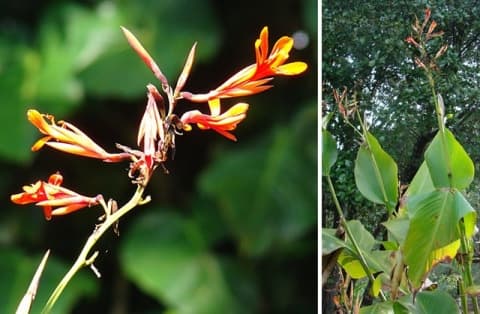
Canna tuerckheimii
Canna tuerckheimii
Safety & Hazards
None known
Cultivation Details
Requires a deep rich well-drained soil in a sunny position[1]. The plant has large leaves and dislikes windy conditions since this can tear the leaves to shreds[1]. Plants are fast-growing, and can produce a flowering shoot in their first year of growth from seed[2]. Slugs love the young growth in spring and can cause serious damage to plants[3].
Propagation
Seed - the different species in this genus often hybridize and so seed cannot be relied upon to breed true. If growing from seed, pre-soak for 24 hours in warm water and sow in the seeds 2 - 5cm deep in individual pots in light shade at 20°c[4, 5]. Scarifying the seed by carefully removing a small part of the outer shell (being careful not to harm the seed itself), to enable it to imbibe water can speed germination, especially if the seed has not swollen after being soaked[6, PFAF]. The seed usually germinates in 3 - 9 weeks[5]. Grow the plants on until large enough to plant out. Division of the root clump as the plant comes into growth. Each portion must have at least one growing point. Pot up the divisions and grow them on until they are well established and then plant them out. Root cuttings. Cite as: Tropical Plants Database, Ken Fern. tropical.theferns.info. 2026-02-20. <tropical.theferns.info/viewtropical.php?id=Canna+tuerckheimii>
Pollinators
Data unavailable
References
- [1]The New RHS Dictionary of Gardening. 1992. — Huxley. A. · MacMillan Press · 1992 · ISBN 0-333-47494-5 ↩︎Excellent and very comprehensive, though it contains a number of silly mistakes. Readable yet also very detailed.
- [2]Flora of N. America — http://flora.huh.harvard.edu/fna/ ↩︎An on-line version of the flora with an excellent description of the plant including a brief mention of plant uses.
- [3]Perennial Garden Plants — Thomas. G. S. · J. M. Dent & Sons, London. · 1990 · ISBN 0 460 86048 8 ↩︎A concise guide to a wide range of perennials. Lots of cultivation guides, very little on plant uses.
- [4]RHS Dictionary of Plants plus Supplement. 1956 — F. Chittendon. · Oxford University Press · 1951 · ISBN - ↩︎Comprehensive listing of species and how to grow them. Somewhat outdated, it has been replaced in 1992 by a new dictionary (see [ 200 ]).
- [5]Growing from Seed. Volume 3. — Bird. R. (Editor) · Thompson and Morgan. · 1989 · ISBN - ↩︎Very readable magazine with lots of information on propagation.
- [6]The Garden. Volume 113. — RHS. · Royal Horticultural Society · 1988 · ISBN - ↩︎Snippets of information from the magazine of the RHS, including details on Podophyllum, Canna and Protea species.
- [7]Flora of Guatemala — Standley P.C. & J. A. Steyermark · 1946 - 1976 · http://www.archive.org/ ↩︎A superb reference, though somewhat dated. Gives lots of plant uses as well as information on plant habit and habitat. The entire flora (13 volumes) can now be downloaded from http://www.archive.org/
- [8]Indicador de Madeiras e Plantas Uteis do Brasil. — Fonseca E. T. De · Officinas graphicas Villas-Boas & Co.; Rio de Janeiro · 1922 · http://www.biodiversitylibrary.org ↩︎Brief details of some of the uses of Brazilian plants. It can be downloaded from the Internet.
- [9]Dictionary of Economic Plants. — Uphof. J. C. Th. · Weinheim · 1959 · ISBN - ↩︎An excellent and very comprehensive guide but it only gives very short descriptions of the uses without any details of how to utilize the plants. Not for the casual reader.
- [PFAF]Plants for a Future — pfaf.org ↩︎