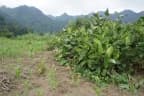
Canna edulis
Canna edulis
Safety & Hazards
None known
Cultivation Details
Canna edulis is a plant of higher elevations in the tropics, ascending to around 2,900 metres. It is very amenable to cultivation in the subtropics and can also be grown outdoors as a summer bedding plant in warmer regions of the temperate zone. It grows best in areas where annual daytime temperatures are within the range 20 - 30°c, but can tolerate 9 - 32°c[1]. The top growth tolerates light frosts and plants can be grown in areas with winter snow[2]. Mature top growth can be killed by temperatures of -2°c or lower, whilst fresh young growth is severely damaged at 0°c[1]. It prefers a mean annual rainfall in the range 1,200 - 1,700mm, but tolerates 250 - 4,000mm[1]. Requires a deep rich well-drained soil in a sunny position[3, 4]. Tolerates heavy soils[2]. The plant has large leaves and dislikes windy conditions since this can tear the leaves to shreds[4]. Requires ample water in the growing season[2]. Prefers a pH in the range 5.5 - 6.5, tolerating 4.5 - 8[2, 1]. Plants are fast-growing, and can produce a flowering shoot in their first year of growth from seed[5]. Achira is sometimes cultivated as a root crop, especially at higher elevations in S. America. There are some named varieties[6, 2]. The root can be harvested within 6 months from planting out, though larger yields are obtained after 8 - 10 months[2]. In warm temperate climates this probably means 2 years growth is required for good yields[PFAF]. Yields in the Andes range from 13 - 85 tonnes per hectare, with 22 - 50 tonnes being average[2]. The plant is possibly hardy in the mildest areas of Britain but even then it should be given a good mulch if left in the ground overwinter[3]. The tubers can be harvested in late autumn after the top growth has been killed back by frost and stored over winter. They should be kept in a frost-free place covered in moist soil or leaves[3]. Most cultivated forms do not produce fertile seed[2]. There are also sterile triploid forms, these contain a significantly higher proportion of starch though their cropping potential is not known[2]. Plants are rarely troubled by pests or diseases[2]. Slugs love the young growth in spring and can cause serious damage to plants[7].
Propagation
Seed - the different species in this genus often hybridize and so seed cannot be relied upon to breed true. If growing from seed, pre-soak for 24 hours in warm water and sow in the seeds in late winter/early spring, 2 - 5cm deep in individual pots in light shade in a greenhouse at 20°c[3, 8]. Scarifying the seed by carefully removing a small part of the outer shell (being careful not to harm the seed itself), to enable it to imbibe water can speed germination, especially if the seed has not swollen after being soaked[9, PFAF]. The seed usually germinates in 3 - 9 weeks[8]. Grow the plants on in a greenhouse for at least their first winter. Plant them out into their permanent positions in late spring or early summer, after the last expected frosts. Division of the root clump as the plant comes into growth in the spring. Each portion must have at least one growing point. Pot up the divisions and grow them on in the greenhouse until they are well established and then plant them out in the summer. Root cuttings. Cite as: Temperate Plants Database, Ken Fern. temperate.theferns.info. 2026-02-20. <temperate.theferns.info/plant/Canna+edulis>
Pollinators
Hummingbirds
References
- [1]Ecocrop — http://ecocrop.fao.org/ecocrop/srv/en/home ↩︎Basic information on a wide range of useful plants, plus details of environmental needs where available.
- [2]Lost Crops of the Incas — Popenoe. H. et al · National Academy Press · 1990 · ISBN 0-309-04264-X ↩︎An excellent book. Very readable, with lots of information and good pictures of some lesser known food plants of S. America.
- [3]RHS Dictionary of Plants plus Supplement. 1956 — F. Chittendon. · Oxford University Press · 1951 · ISBN - ↩︎Comprehensive listing of species and how to grow them. Somewhat outdated, it has been replaced in 1992 by a new dictionary (see [ 200 ]).
- [4]The New RHS Dictionary of Gardening. 1992. — Huxley. A. · MacMillan Press · 1992 · ISBN 0-333-47494-5 ↩︎Excellent and very comprehensive, though it contains a number of silly mistakes. Readable yet also very detailed.
- [5]Flora of N. America — http://flora.huh.harvard.edu/fna/ ↩︎An on-line version of the flora with an excellent description of the plant including a brief mention of plant uses.
- [6]Dictionary of Economic Plants. — Uphof. J. C. Th. · Weinheim · 1959 · ISBN - ↩︎An excellent and very comprehensive guide but it only gives very short descriptions of the uses without any details of how to utilize the plants. Not for the casual reader.
- [7]Perennial Garden Plants — Thomas. G. S. · J. M. Dent & Sons, London. · 1990 · ISBN 0 460 86048 8 ↩︎A concise guide to a wide range of perennials. Lots of cultivation guides, very little on plant uses.
- [8]Growing from Seed. Volume 3. — Bird. R. (Editor) · Thompson and Morgan. · 1989 · ISBN - ↩︎Very readable magazine with lots of information on propagation.
- [9]The Garden. Volume 113. — RHS. · Royal Horticultural Society · 1988 · ISBN - ↩︎Snippets of information from the magazine of the RHS, including details on Podophyllum, Canna and Protea species.
- [10]Flora of Guatemala — Standley P.C. & J. A. Steyermark · 1946 - 1976 · http://www.archive.org/ ↩︎A superb reference, though somewhat dated. Gives lots of plant uses as well as information on plant habit and habitat. The entire flora (13 volumes) can now be downloaded from http://www.archive.org/
- [11]The Ethno-Botany of Pre-Columbian Peru. — Towle. M. A. · Aldine Publishing Co. Chicago. · 1961 ↩︎A very interesting book covering quite a lot of information on plant uses in S. America although many of the plants are not suitable for temperate areas.
- [12]Sturtevant's Edible Plants of the World. — Hedrick. U. P. · Dover Publications · 1972 · ISBN 0-486-20459-6 ↩︎Lots of entries, quite a lot of information in most entries and references.
- [13]Alternative Foods. — Sholto-Douglas. J. ↩︎Not very comprehensive, it seems more or less like a copy of earlier writings with little added.
- [14]Economic Botany. — Hill. A. F. · The Maple Press · 1952 · ISBN - ↩︎Not very comprehensive, but it is quite readable and goes into some detail about the plants it does cover.
- [15]Cornucopia - A Source Book of Edible Plants. — Facciola. S. · Kampong Publications · 1990 · ISBN 0-9628087-0-9 ↩︎Excellent. Contains a very wide range of conventional and unconventional food plants (including tropical) and where they can be obtained (mainly N. American nurseries but also research institutes and a lot of other nurseries from around the world.
- [16]A Dictionary of Plants Used by Man. — Usher. G. · Constable · 1974 · ISBN 0094579202 ↩︎Forget the sexist title, this is one of the best books on the subject. Lists a very extensive range of useful plants from around the world with very brief details of the uses. Not for the casual reader.
- [17]Tanaka's Cyclopedia of Edible Plants of the World. — Tanaka. T. & Nakao S. · Keigaku Publishing; Tokyo · 1976 · ISBN - ↩︎The most comprehensive list of edible plants I've come across. Only the briefest entry for each species, though, and some of the entries are more than a little dubious. Not for the casual reader.
- [18]Plants Consumed by Man. — Brouk. B. · Academic Press · 1975 · ISBN 0-12-136450-x ↩︎Readable but not very comprehensive.
- [19]Plants for Human Consumption. — Kunkel. G. · Koeltz Scientific Books · 1984 · ISBN 3874292169 ↩︎An excellent book for the dedicated. A comprehensive listing of Latin names with a brief list of edible parts.
- [PFAF]Plants for a Future — pfaf.org ↩︎