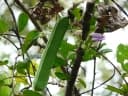
Canavalia ensiformis
Canavalia ensiformis
Cultivation Details
The plant can be grown in temperate to tropical areas at elevations up to 1,500 metres[2]. It grows best in areas where annual daytime temperatures are within the range 20 - 28°c, but can tolerate 14 - 36°c[2]. The foliage is intolerant of frost, but mature beans are unaffected[2]. It prefers a mean annual rainfall in the range 800 - 2,000mm, but tolerates 600 - 4,300mm[2]. An easily grown plant, it is not fussy about soil type or fertility, though it prefers a soil rich in organic matter[1]. Plants prefer a sunny position, but are somewhat shade tolerant[1]. A deep rooted plant, it is drought resistant when established[1]. Prefers a pH in the range 5 - 6, tolerating 4.3 - 8[2]. Young pods can be harvested about 4 months after sowing[1]. Green pods can be harvested after 80 - 120 days, and mature seed after 180 - 300 days[2]. Yields of about 1 - 1.3 tonnes of dried seed can be obtained[1]. The optimum yield is 5.4 tonnes/ha of dry seed, while the average yield is about 1.3 tonnes/ha[2]. 40 - 50 tonnes/ha of green manure/green vegetation can be obtained[2]. A short day plant, often developing a bushy habit, but more commonly a climbing plant[1]. This species has a symbiotic relationship with certain soil bacteria, these bacteria form nodules on the roots and fix atmospheric nitrogen. Some of this nitrogen is utilized by the growing plant but some can also be used by other plants growing nearby[3]. When removing plant remains at the end of the growing season, it is best to only remove the aerial parts of the plant, leaving the roots in the ground to decay and release their nitrogen.
References
- [1]Vegetables in the Tropics — Tindall. H. D. · MacMillan, Oxford. · 1983 · ISBN 0-333-24268-8 ↩︎An excellent, in-depth look at the main vegetable crops that can be grown in the Tropics, plus many less well-known plants.
- [2]Ecocrop — http://ecocrop.fao.org/ecocrop/srv/en/home ↩︎Basic information on a wide range of useful plants, plus details of environmental needs where available.
- [3]The New RHS Dictionary of Gardening. 1992. — Huxley. A. · MacMillan Press · 1992 · ISBN 0-333-47494-5 ↩︎Excellent and very comprehensive, though it contains a number of silly mistakes. Readable yet also very detailed.
- [4]Flowering Plants of Jamaica — Adams. C.D. · University of the West Indies; Jamaica. · 1972 ↩︎A terse treatment of the flowering plants of Jamaica, with a botanical description of each plant, notes on habitat etc.
- [5]Cornucopia II — Facciola. S. · Kampong Publications, California. · 1998 · ISBN 0-9628087-2-5 ↩︎The second edition of an excellent guide to the edible uses of plants, though it does not give any details of cultivation etc.
- [6]Dictionary of Economic Plants. — Uphof. J. C. Th. · Weinheim · 1959 · ISBN - ↩︎An excellent and very comprehensive guide but it only gives very short descriptions of the uses without any details of how to utilize the plants. Not for the casual reader.
- [PFAF]Plants for a Future — pfaf.org ↩︎