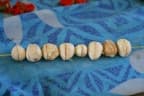
Canarium indicum
Canarium indicum
Safety & Hazards
None known
Cultivation Details
Canarium indicum is a plant of the lowland, subhumid to humid tropics, found at elevations from sea level to about 600 metres[1]. It experiences very warm temperatures throughout the year with a mean annual temperature of 25 - 28°c; and an annual rainfall in the range of 1,800 - 4,000 mm[1]. Plants are usually found in areas where the dry season is less than 2 months, but they can tolerate up to 4 months dry season[1]. Prefers a medium to heavy-textured soil of moderate to high fertility[1]. Intolerant of shallow, infertile, or saline soils[1]. Fruits best in a position with little or no shade, though young trees grow best in semi-shade[1]. Plants succeed with free to slightly impeded drainage and a neutral pH[1]. Prefers a pH in the range 6.1 - 7.4[1]. Plants are fairly tolerant of strong winds, quickly recovering if any damage is caused[1]. The tree has a minor potential to become invasive[1]. Plants grow fairly slowly during their first year, usually reaching 0.6 - 2 metres in height[1]. After that, the growth rate increases with annual height increases of 2.5 - 3 metres common for the next 5 - 6 years[1]. Trees produce a deep taproot[1]. Plants can commence fruiting when about 7 years old[1]. Annual yields have been estimated at up to 4 - 7 tonnes of kernels per hectare[1]. Selection of plants over the centuries has led to a number of distinct forms with thinner shells and larger seeds[1]. Plants are most commonly dioecious, meaning that both male and female forms need to be grown if seed is required. However, some trees also bear hermaphrodite flowers plus either male or female flowers[1].
Propagation
Seed -pre-soak in fresh water for 24 hours prior to sowing[1]. Discard any nuts that float or that do not sink completely to the bottom[1]. Seed should be sown 1 cm deep on their sides directly into large pots or polybags, or 3 - 4 can be sown together direct into the position where the tree is to grow[1]. Nursery grown plants are usually ready to plant out when they are about 3 months old, by which time they should be up to 30cm tall[1]. The seed has a short viability and should be sown as soon as possible after collection. If seeds need to stored for a few weeks, then the outer flesh should be removed and the nut-in-shell stored in a shaded, cool (e.g., 15 - 25°C) dry place, secure from rodents and other pests[1]. Cite as: Tropical Plants Database, Ken Fern. tropical.theferns.info. 2026-02-20. <tropical.theferns.info/viewtropical.php?id=Canarium+indicum>
Pollinators
Data unavailable
References
- [1]Traditional Trees of Pacific Islands — Elevitch. Craig. R. (Editor) · Permanent Agriculture Resources, Hawaii · 2006 · ISBN 0970254458 ↩︎Beautifully produced book with superb photos and detailed information on over 50 species of useful plants of the Pacific Islands.
- [2]Trees of Laos and Vietnam - A Field Guide to 100 species. — Hoang Van Sam; Khamseng Nanthavong; Kessler P.J.A. · Blumea · 2004 ↩︎A detailed guide, with excellent line-drawings, to 100 of the more important trees of Laos and Vietnam. A very good work, giving lots of information about each plant. Originally published in the journal Blumea, it is available as a PDF on the Interne
- [3]Food Plants of Papua New Guinea — French. B.R. · Author. · 2006 ↩︎Published on-line in PDF format, this book contains information on several hundred New Guinea food plants.
- [4]South Pacific Indigenous Nuts. ACIAR Proceedings No 69 — Stevens M.L.; Bourke R.M. & Evans B.R. · Australian Centre for International Agricultural Research; Canbe · 1996 · ISBN 1 86320 175 0 ↩︎Proceedings of a workshop held from 31 October to 4 November 1994 at Le Lagon Resort, Port Vila, Vanuatu.
- [5]Edible Nuts. — Wickens G.E. · FAO, Rome. · 1995 · http://www.fao.org/docrep/ · ISBN 92-5-103748-5 ↩︎Detailed information on 20 of the most valuable nut crops, plus more basic information on a wide range of other nut-producing plants. It can be downloaded from the Internet.
- [6]Guide to the Trees of Papua New Guinea — Conn. B.J. & Damas. K.Q. · http://www.pngplants.org/PNGtrees/ ↩︎An Internet site giving good descriptions of the trees of Papua New Guinea.
- [7]Plant Resources of Southeast Asia — http://proseanet.org/ ↩︎Lots of information on the uses of the plants of SE Asia.
- [8]National Tropical Botanical Garden — http://ntbg.org/plants/choose_a_plant.php ↩︎General information on almost 400 species, with descriptions, habitats and some uses.
- [9]Medicinal Plants in Papua New Guinea — World Health Organisation · 2009 · ISBN 978-92-9061-249-0 ↩︎Traditional medicinal uses of 126 species from Papua New Guinea, including information on modern research into the plants.