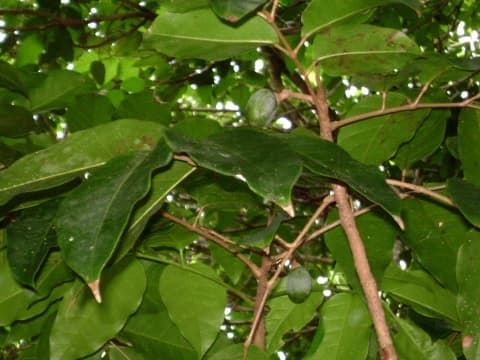
Canarium harveyi
Canarium harveyi
Safety & Hazards
None known
Cultivation Details
A plant of the lowland, subhumid to humid tropics where temperatures are very warm to hot throughout the year. The mean annual temperature is around 23 - 28°c. The absolute minimum temperature experienced is 8 - 19°c[1]. The mean annual rainfall is 1800 - 4000 mm, distributed rather uniformly or with a summer maximum[1]. Prefers growing in medium to heavy-textured soils with free to slightly impeded drainage and a circum-neutral pH[1]. Trees may be heavily pruned during fruit collection. This results in a low fruit set the following year, followed by a very heavy crop the year after[1]. A dioecious species, both male and female forms need to be grown if fruit and seed are required[2].
Propagation
Seed -pre-soak in fresh water for 24 hours prior to sowing[1]. Discard any nuts that float or that do not sink completely to the bottom[1]. Seed should be sown 1 cm deep on their sides directly into large pots or polybags, or 3 - 4 can be sown together direct into the position where the tree is to grow[1]. Nursery grown plants are usually ready to plant out when they are about 3 - 5 months old, by which time they should be up to 30cm tall[1]. The seed has a short viability and should be sown as soon as possible after collection. If seeds need to stored for a few weeks, then the outer flesh should be removed and the nut-in-shell stored in a shaded, cool (e.g., 15 - 25°C) dry place, secure from rodents and other pests[1]. Cite as: Tropical Plants Database, Ken Fern. tropical.theferns.info. 2026-02-20. <tropical.theferns.info/viewtropical.php?id=Canarium+harveyi>
Pollinators
Data unavailable
References
- [1]Traditional Trees of Pacific Islands — Elevitch. Craig. R. (Editor) · Permanent Agriculture Resources, Hawaii · 2006 · ISBN 0970254458 ↩︎Beautifully produced book with superb photos and detailed information on over 50 species of useful plants of the Pacific Islands.
- [2]Flora Malesiana Series 1 — Various · Nationaal Herbarium Nederiand, Universiteit Leiden branch · http://www.archive.org ↩︎A massive treatment of the plants of the Malaysian Archipelago. Much of it has been made available to download from the Internet